
Collaboration between teams · with Diamonds
One community, not five teams
Teams prospect for diamonds with a budget, scattered clues and one objective read word for word, discover after stage 2 who their community really was, estimate what working together from the start would have yielded, and take one habit back to a real interface at work.
- 90 minutes (default) · About 2 hours 10 (full format) · Half day · 100 minutes online
- 9 to 36 people in 3 to 6 teams of 3 to 6. At least three teams, so the community is bigger than a pair. One facilitator up to about 30 people; add a co-facilitator or observers above that.
Free with every account, 100 credits included. In the app since 2 October 2026.
What happens in the session
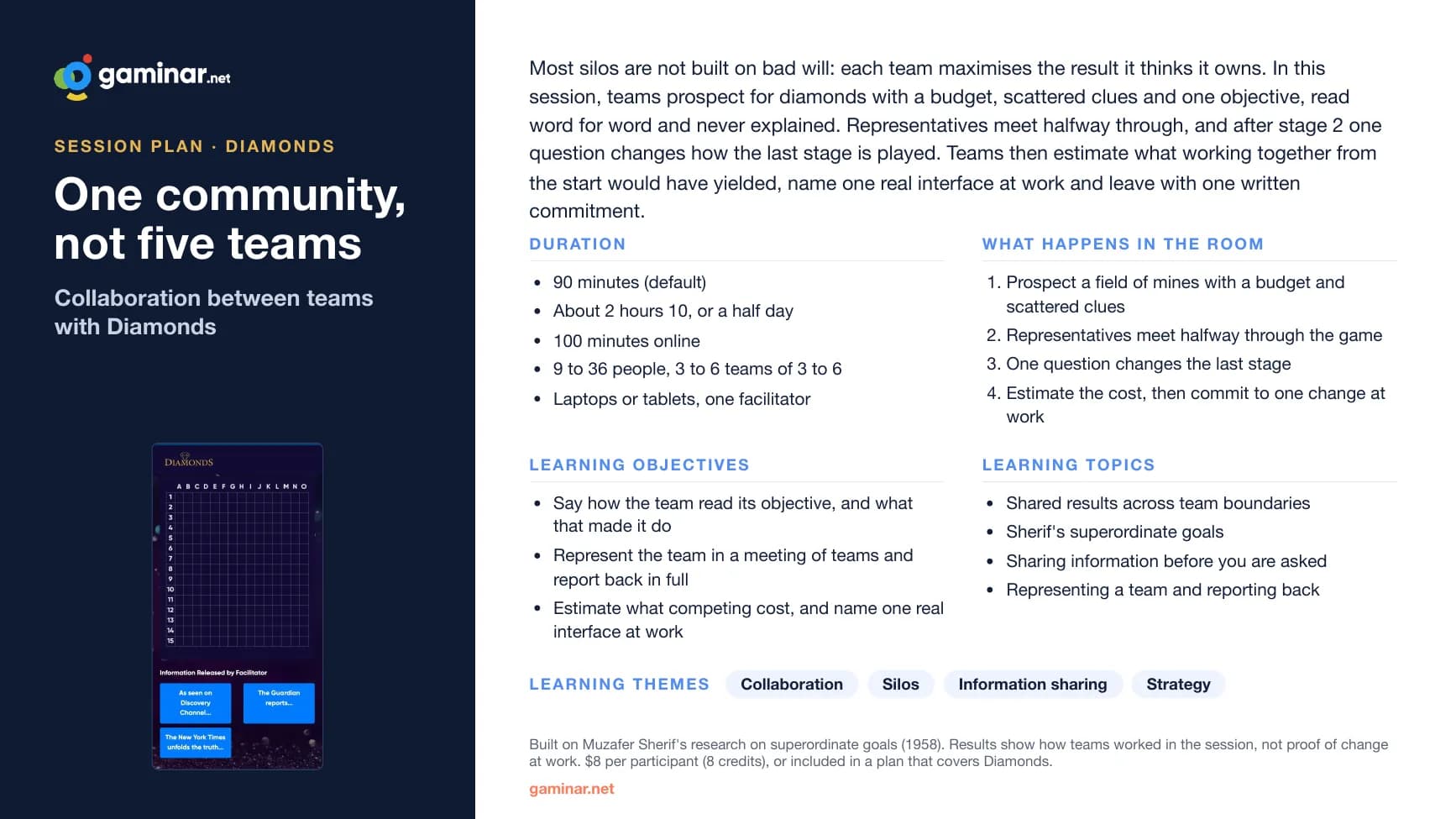
Most silos are not built on bad will: each team maximises the result it thinks it owns. In this session, teams prospect for diamonds with a budget, scattered clues and one objective, read word for word and never explained. Representatives meet halfway through, and after stage 2 one question changes how the last stage is played. Teams then estimate what working together from the start would have yielded, name one real interface at work and leave with one written commitment.
A story you will recognise
After a merger, a distribution company keeps its two regional sales teams, each with its own target and its own pipeline report. Both teams chase the same three national accounts. One customer receives two proposals with two different prices in the same week, and the team that lost the deal kept back what it knew about the buyer. Each team hits most of its own number; the company loses one account and discounts another. Nobody acted in bad faith: each team maximised the result it thought it owned. This session lets the group live that pattern in a game, where it costs nothing, and name the real interface where it is happening now.
Who it is for
Cross-functional groups, department heads and integration programmes: any group whose teams share a result but are measured, rewarded or seated as if they were competitors.
Use it when
- Two or more departments share a result but blame each other for it, or keep information from each other.
- An integration programme after a merger or reorganisation needs the old teams to see one shared result.
- Department heads with separate targets and one shared P&L need a module that starts from evidence in the room.
- A cross-functional group duplicates work: two teams buy the same data, chase the same customer, run the same analysis.
Pick another plan when
- Anyone in the group has played Diamonds before and cannot be made an observer: the twist only lands once.
- The teams really are meant to compete, for example rival bids for the same budget. Say so instead of playing.
- Relations between two departments are openly hostile about people, not about the work. Deal with that first.
- The sponsor wants the theme announced in advance. The session depends on nobody expecting it.
Learning objectives
What people leave able to do
- 1
Say, with evidence from the game, how the team read 'the wealth of your community' and how that reading shaped what it did in stages 1 and 2.
- 2
Represent the team at the conference and report back to it what was shared, what was held back and what was misread.
- 3
Estimate what the community could have had if teams had collaborated from stage 1, and name one real interface at work where teams compete while sharing a result.
The model
Superordinate goals (Muzafer Sherif)
In the Robbers Cave study (summer 1954), Sherif and his colleagues split boys at a summer camp into two groups. Competing for prizes made the groups hostile, and simply bringing them together did not fix it. What reduced the hostility was a series of superordinate goals: goals both groups wanted and neither could reach alone. Diamonds hands every team a superordinate goal in the first minute, and most groups do not see it until someone names it. The four habits below are this session's way of turning Sherif's idea into behaviour you can see in a room; they are not his list.
Name the shared result
At work: Open a meeting with another team by naming the number both teams are judged on.
Share before you are asked
At work: Send the forecast, the customer complaint or the risk to the other team before they need it.
Split the work, not the result
At work: Agree who runs which analysis, call or account, so two teams never pay for the same work.
Report back in full
At work: After a meeting with another team, tell your own team what the other side needs, including the parts you did not like.
Source: Muzafer Sherif, 'Superordinate goals in the reduction of intergroup conflict', American Journal of Sociology 63(4), 1958, pages 349 to 356; Muzafer Sherif, O. J. Harvey, B. Jack White, William R. Hood and Carolyn W. Sherif, 'Intergroup Conflict and Cooperation: The Robbers Cave Experiment', University of Oklahoma Book Exchange, 1961.
The session at a glance
The 90-minute version. The pack has the script for every block.
| Clock | Min | Block |
|---|---|---|
| 0:00 | 4 | Join |
| 0:04 | 4 | Open and prebrief |
| 0:08 | 5 | Briefing |
| 0:13 | 20 | Stage 1 |
| 0:33 | 5 | Between stages 1 and 2 |
| 0:38 | 15 | Stage 2 and the conference |
| 0:53 | 5 | The question |
| 0:58 | 10 | Stage 3 |
| 1:08 | 2 | Results |
| 1:10 | 7 | Debrief 1: Feel and What |
| 1:17 | 3 | The model |
| 1:20 | 4 | The estimate |
| 1:24 | 2 | Now what |
| 1:26 | 3 | Commitment |
| 1:29 | 1 | Close |
In the full plan
- A minute-by-minute run sheet for 90 minutes, with 60-minute, half-day and online versions
- A script: what to say, what to ask and what to listen for
- The debrief, step by step, and how to carry it back to work
- A one-page handout per participant and an observer sheet
- Slides with speaker notes, and a one-pager to send your client
Word and PowerPoint, so you can make it yours. Read once. 20 minutes of set-up on the day, plus one rehearsal on the public Diamonds demo.
One Diamonds session: 8 credits ($8) per participant who joins, or included in a plan that covers Diamonds. Everything after the game is on paper and costs nothing. A second Diamonds session is billed again, 8 credits per participant, unless a plan covers it; with the same people it is not worth it anyway, because the twist only works once.
More with Diamonds
Other session plans on the same game
Rehearse it for free before your first real group
Sign up in two minutes, get 100 free credits, and rehearse any game as often as you like: sessions with up to 2 participants are always free.