
Deciding with incomplete information · with Diamonds
Test before you bet
Teams prospect for diamonds with a budget and scattered clues, read their own log of tests and bets between stages, learn when a cheap test beats a big bet and what a clue is worth, and plan the first small test for a real decision of their own.
- 90 minutes (default) · About 2 hours 10 (full format) · Half day (strategy version) · 100 minutes online
- 6 to 36 people in 2 to 6 teams of 3 to 6. One facilitator up to about 30 people; add a co-facilitator or observers above that.
Free with every account, 100 credits included. It arrives in the app's Resources on 16 October 2026; sign up now and it is there that morning.
What happens in the session
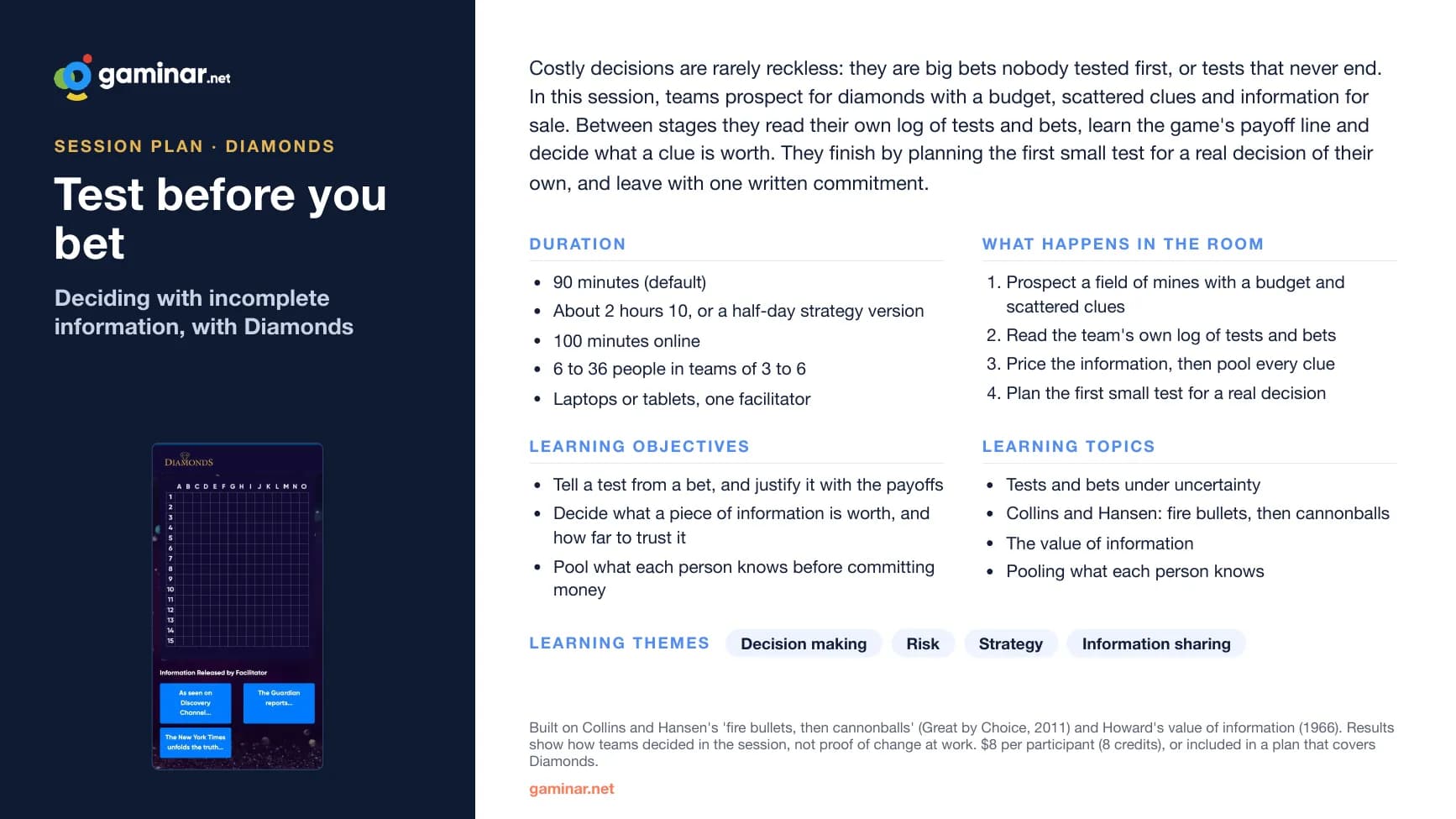
Costly decisions are rarely reckless: they are big bets nobody tested first, or tests that never end. In this session, teams prospect for diamonds with a budget, scattered clues and information for sale. Between stages they read their own log of tests and bets, learn the game's payoff line and decide what a clue is worth. They finish by planning the first small test for a real decision of their own, and leave with one written commitment.
A story you will recognise
A retailer's leadership team decides to convert forty stores to a new format at once. The concept scored well in a customer survey, nobody ran a pilot store, and the regional manager who had seen a similar format fail at another chain was never asked. Eighteen months later half the stores are converted back, at several times the cost of a pilot. Nobody gambled on purpose: the team never said out loud which part of the plan was a test and which was a bet. This session lets the group feel that difference in a game, where it costs nothing, and practise it before the next real budget.
Who it is for
Managers, project and operations leads, analysts and strategy groups: anyone who commits budget, people or time before all the facts are in.
Use it when
- A team commits big budgets on the strength of one report, one customer or one confident voice.
- A team cannot commit at all: every decision waits for more data that never settles it.
- A strategy, project or innovation programme needs a module on piloting and staged commitment, with evidence from the room.
- What a decision needs to know sits with different people or functions, and reaches the decision late or never.
Pick another plan when
- You also plan to run 'One community, not five teams', the other Diamonds pack, with the same people. Its twist only lands once: run that pack first, or instead of this one.
- The group needs a formal decision-analysis method (decision trees, real options). This session builds habits and the arithmetic of one game, not the method.
- The team is in open conflict about people rather than about decisions. Deal with that first.
Learning objectives
What people leave able to do
- 1
Classify a move as a test (explore, 1,000) or a bet (mine, 2,000) and justify the choice with the game's payoffs, in the team's stage 2 rule and in the debrief.
- 2
Decide whether an information card is worth 1,000 and how far to trust it, and state the criterion the team used.
- 3
Pool the free clues held by different team members before committing money to an area, and compare how often that happened in stages 1, 2 and 3.
The model
Fire bullets, then cannonballs (Collins and Hansen), and the value of information (Howard)
Collins and Hansen compared companies that thrived in uncertain, fast-moving industries with similar companies that did not. Among the habits that set the winners apart: they fired bullets first, small tests that are low in cost, low in risk and low in distraction, and fired a cannonball, a big concentrated bet, only once a bullet had shown them where to aim. A cannonball fired without that evidence they called uncalibrated. Ronald Howard's value of information adds the other half: information is worth buying only when it could change a decision, and only up to what that change is worth. Diamonds prices both ideas exactly: a test costs 1,000, a bet 2,000 and a card 1,000. The five habits below are this session's way of turning the two ideas into behaviour you can see in a room; they are not the authors' lists.
Call it: test or bet
At work: Label each proposal as a test (to learn) or a bet (to win) before anyone argues about it.
Test while you are unsure
At work: When nobody can honestly say 'more likely than not', run a pilot, a sample or a prototype before the budget.
Bet when the evidence is in
At work: When a test has worked, commit fully and on time: an endless pilot is also a bet, on doing nothing.
Price the information
At work: Before paying for a report, a survey or a study, say which decision it could change and how you would check it.
Pool before you commit
At work: Before a big decision, ask each person, and the people outside the room, what they know that bears on it.
Source: Jim Collins and Morten T. Hansen, 'Great by Choice: Uncertainty, Chaos, and Luck. Why Some Thrive Despite Them All', HarperBusiness, 2011, chapter 'Fire Bullets, Then Cannonballs'. Ronald A. Howard, 'Information Value Theory', IEEE Transactions on Systems Science and Cybernetics 2(1), 1966, pages 22 to 26.
The session at a glance
The 90-minute version. The pack has the script for every block.
| Clock | Min | Block |
|---|---|---|
| 0:00 | 4 | Join |
| 0:04 | 4 | Open and prebrief |
| 0:08 | 5 | Briefing |
| 0:13 | 20 | Stage 1 |
| 0:33 | 7 | Test or bet |
| 0:40 | 15 | Stage 2 |
| 0:55 | 7 | Price and pool the information |
| 1:02 | 10 | Stage 3 |
| 1:12 | 2 | Results |
| 1:14 | 6 | Debrief 1: Feel and What |
| 1:20 | 4 | So what: the model |
| 1:24 | 3 | Now what: the bullet plan |
| 1:27 | 2 | Commitment |
| 1:29 | 1 | Close |
In the full plan
- A minute-by-minute run sheet for 90 minutes, with 60-minute, half-day and online versions
- A script: what to say, what to ask and what to listen for
- The debrief, step by step, and how to carry it back to work
- A one-page handout per participant and an observer sheet
- Slides with speaker notes, and a one-pager to send your client
Word and PowerPoint, so you can make it yours. Read once. 20 minutes of set-up on the day, plus one rehearsal on the public Diamonds demo.
One Diamonds session: 8 credits ($8) per participant who joins, or included in a plan that covers Diamonds. The team log, the rules and the bullet plan are on paper and cost nothing. A second Diamonds session is billed again, 8 credits per participant, unless a plan covers it; with the same people it is not worth it anyway, because the field is the same in every session.
More with Diamonds
Other session plans on the same game
Rehearse it for free before your first real group
Sign up in two minutes, get 100 free credits, and rehearse any game as often as you like: sessions with up to 2 participants are always free.