
Building trust · with XY
Trust is built one round at a time
Teams make promises to each other before the rounds that count, see on every phone and on a promise board whether each promise was kept, trace what one broken promise cost over the rounds that followed, and practise the words that repair trust.
- 90 minutes (default) · 60 minutes · Half day · 90 minutes online
- 9 to 36 people in 3 to 6 teams of 3 to 6; four teams is ideal. The app takes 2 to 60 people in 2 to 6 teams. One facilitator up to about 30 people; above that, add a co-facilitator to keep the promise board.
Free with every account, 100 credits included. In the app since 21 October 2026.
What happens in the session
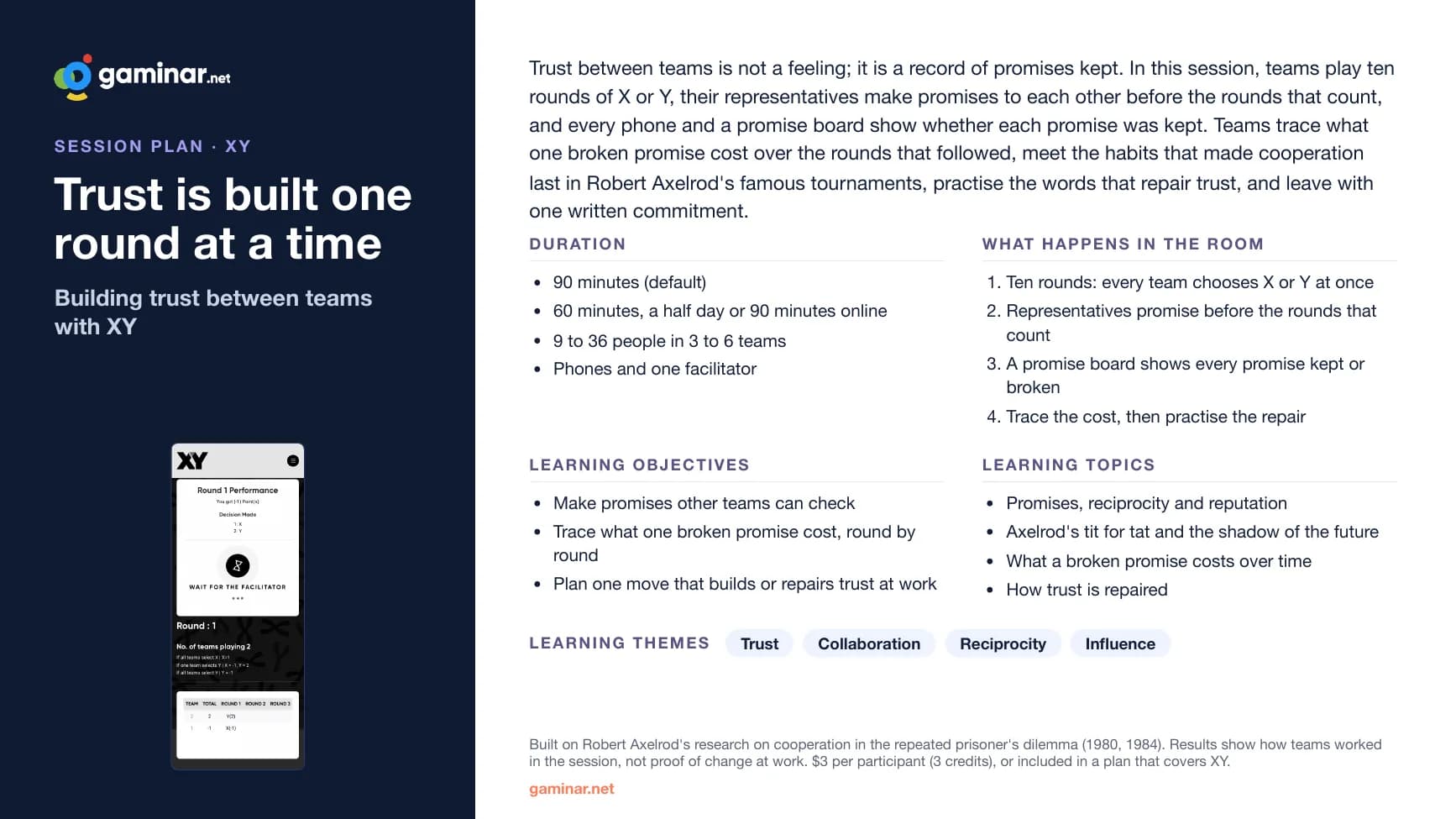
Trust between teams is not a feeling; it is a record of promises kept. In this session, teams play ten rounds of X or Y, their representatives make promises to each other before the rounds that count, and every phone and a promise board show whether each promise was kept. Teams trace what one broken promise cost over the rounds that followed, meet the habits that made cooperation last in Robert Axelrod's famous tournaments, practise the words that repair trust, and leave with one written commitment.
A story you will recognise
At a food plant, production and maintenance agree every Friday which lines maintenance may stop for servicing the following week. One Friday, production promises line 3 for Tuesday, then runs it anyway to catch up on a late order, and says nothing. Maintenance stops booking planned work through the Friday meeting and starts declaring breakdowns, which production cannot refuse; six weeks later, unplanned stops are up and each team keeps a list of the other's broken promises. This session lets the group see in a game how one broken promise costs more over the following rounds than it ever earned, and practise how trust is rebuilt.
Who it is for
Teams that depend on each other's promises: production and maintenance, sales and delivery, head office and the regions, partners in a joint project. Also leadership and partnership programmes on trust and reciprocity.
Use it when
- Teams depend on each other's promises (dates, slots, handovers) and each keeps a list of the other's broken ones.
- Two teams are stuck in tit for tat: one let the other down, the other paid it back, and nobody remembers who started.
- A partnership, joint venture or new cross-team project needs to agree how promises are made, checked and repaired before the pressure arrives.
- A leadership programme needs a module on trust that starts from evidence in the room, not from a questionnaire.
Pick another plan when
- Trust was broken by something serious at work, such as an accusation, a dismissal or a legal dispute: a game will feel like a trivialisation. Deal with it directly first.
- Anyone in the group has played XY, or another game with an X and Y choice, and cannot be made an observer.
- The problem is that teams are ranked against each other (Win together, not against each other fits better) or that representatives cannot negotiate an agreement (Grow the pie before you split it).
- The group is in open conflict about people rather than about the work. Deal with that first.
Learning objectives
What people leave able to do
- 1
Make promises to the other teams in words anyone can check after the next round, and tell the team exactly what every other team promised.
- 2
Trace, from the promise board and the final table, what the first broken promise cost the room and the team that broke it, in points and in rounds.
- 3
Write the three sentences that repair a broken promise, and plan one move that builds or repairs trust with a real team at work.
The model
Cooperation that lasts (Robert Axelrod)
In two computer tournaments reported in 1980, Robert Axelrod invited experts to submit strategies for the repeated prisoner's dilemma, where two players choose again and again between cooperating and defecting, much as teams choose between X and Y. The winner both times, submitted by Anatol Rapoport, was the simplest entry, Tit for Tat: cooperate first, then do whatever the other player did in the round before. Axelrod's explanation: it was nice (never the first to defect), retaliatory (it answered a defection at once), forgiving (it went back to cooperating as soon as the other did) and clear (others soon saw what it would do). It never scored more than the player it was paired with; it did well because it drew cooperation out of others. Cooperation also needs what Axelrod called the shadow of the future: it lasts while the next rounds matter enough, and XY makes them matter on purpose, with rounds 8 and 10 worth five and ten times a normal round. One thing XY adds to his two-player game: with more than two teams, a Y aimed at one team hits every team that chose X. The last habit, for the team that broke a promise, comes from Charles Osgood's step-by-step way of reducing tension: announce a cooperative move, make it, and keep making it. The five habits are this session's translation for a room; they are not Axelrod's own list.
Go first with X
At work: Make the first cooperative move: share the plan, hold the slot, keep the date, before you are sure the other team will.
Answer a broken promise once, out loud
At work: Say clearly, once, that a promise was broken and what you will do next time; do not punish the whole relationship for it.
Forgive and go back to X
At work: When the other team keeps its next promise, close the matter; do not bring it up at every meeting.
Make your rule easy to read
At work: Tell the other team how you work with them: what you will always do, and what happens when a promise is broken.
Repair out loud
At work: After you let another team down, say what happened without excuses, say what you will do from when, do it, and keep doing it until they believe it.
Source: Robert Axelrod, 'Effective Choice in the Prisoner's Dilemma', Journal of Conflict Resolution 24(1), 1980, pages 3 to 25; Robert Axelrod, 'The Evolution of Cooperation', Basic Books, 1984. For the repair habit: Charles E. Osgood, 'An Alternative to War or Surrender', University of Illinois Press, 1962.
The session at a glance
The 90-minute version. The pack has the script for every block.
| Clock | Min | Block |
|---|---|---|
| 0:00 | 4 | Join |
| 0:04 | 4 | Open and prebrief |
| 0:08 | 6 | Briefing |
| 0:14 | 9 | Rounds 1 to 3 |
| 0:23 | 5 | Meeting 1: promises for rounds 4 to 6 |
| 0:28 | 7 | Rounds 4 to 6 |
| 0:35 | 4 | Meeting 2: promises for rounds 7 to 9 |
| 0:39 | 7 | Rounds 7 to 9 |
| 0:46 | 3 | Meeting 3: the last promise |
| 0:49 | 3 | Round 10 |
| 0:52 | 4 | Results |
| 0:56 | 9 | Debrief 1: Feel and What |
| 1:05 | 5 | The model |
| 1:10 | 6 | The cost of the first broken promise |
| 1:16 | 4 | Repair |
| 1:20 | 3 | Now what |
| 1:23 | 5 | Commitment |
| 1:28 | 2 | Close |
In the full plan
- A minute-by-minute run sheet for 90 minutes, with 60-minute, half-day and online versions
- A script: what to say, what to ask and what to listen for
- The debrief, step by step, and how to carry it back to work
- A one-page handout per participant and an observer sheet
- Slides with speaker notes, and a one-pager to send your client
Word and PowerPoint, so you can make it yours. Read once. 20 minutes of set-up on the day, including the promise board, plus one free rehearsal with your phone as team 1 and a private browser window as team 2.
One XY session: 3 credits ($3) per participant who joins, or included in a plan that covers XY (the $175 XY plan, or the Bundle). Observers who do not join cost nothing, and a rehearsal with up to two participants is free. The promise board and the repair work are on paper and cost nothing. Your first session with a group is free for up to 30 participants.
More with XY
Other session plans on the same game
Collaboration between teams
Win together, not against each other
See the planNegotiation between teams
Grow the pie before you split it
See the plan
Rehearse it for free before your first real group
Sign up in two minutes, get 100 free credits, and rehearse any game as often as you like: sessions with up to 2 participants are always free.