
Collaboration between teams · with XY
Win together, not against each other
Teams play ten rounds of X or Y to maximize their team's points, with a league table on every phone, then discover what the whole room scored against the 24 points every team could have had, count what competing cost, and take one change back to a real scoreboard at work.
- 90 minutes (default) · 60 minutes · Half day · 75 minutes online
- 9 to 36 people in 3 to 6 teams of 3 to 6; four teams is ideal. The app takes 2 to 60 people in 2 to 6 teams. One facilitator up to about 30 people; add observers above that.
Free with every account, 100 credits included. In the app since 21 October 2026.
What happens in the session
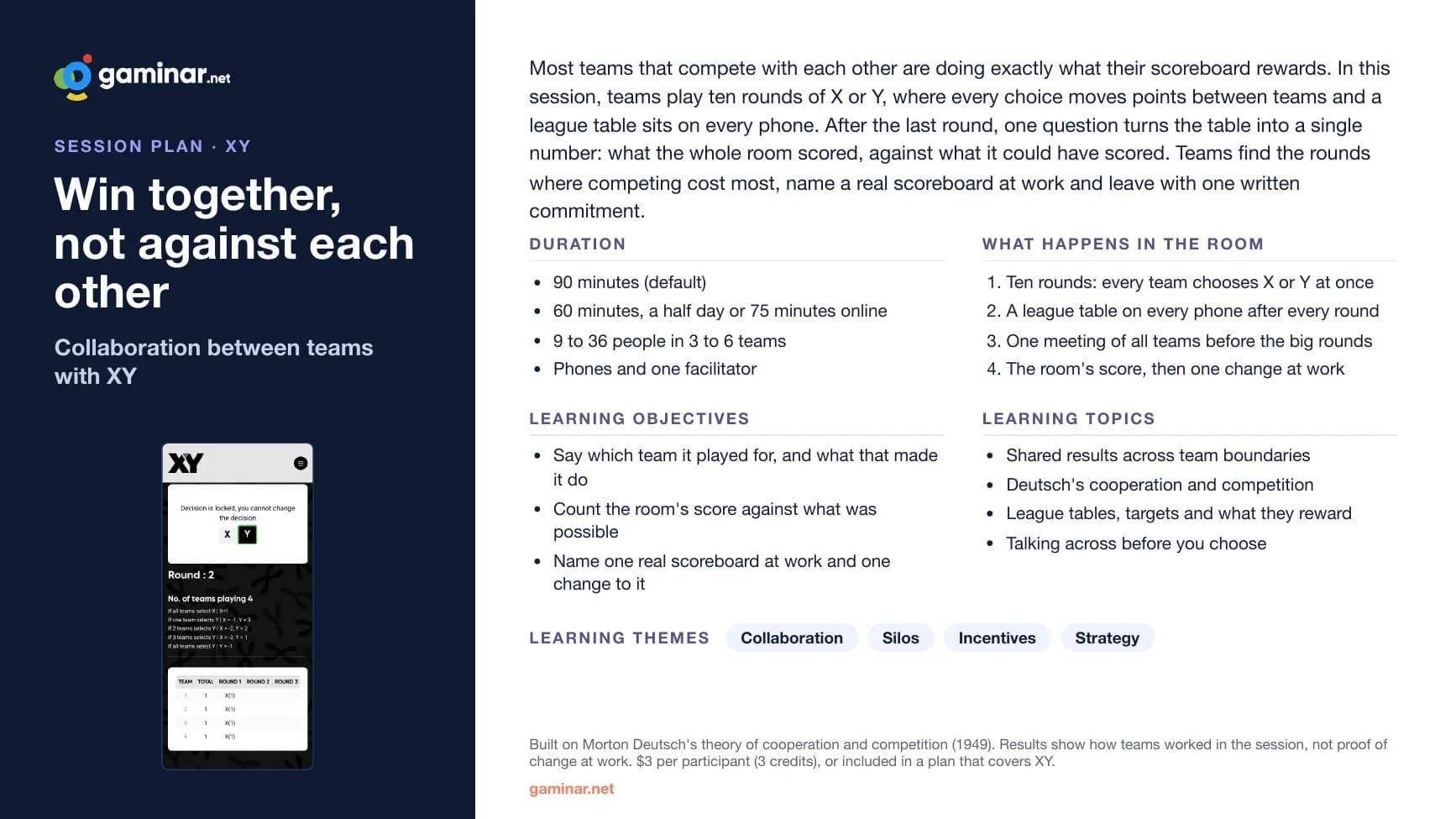
Most teams that compete with each other are doing exactly what their scoreboard rewards. In this session, teams play ten rounds of X or Y, where every choice moves points between teams and a league table sits on every phone. After the last round, one question turns the table into a single number: what the whole room scored, against what it could have scored. Teams find the rounds where competing cost most, name a real scoreboard at work and leave with one written commitment.
A story you will recognise
A retail chain ranks its eight city stores every Monday on sales against target, and only the top three managers earn a bonus. When a customer asks for a size a store does not have, nobody phones the store across town any more, because the sale would lift a rival in the table. Two stores run the same promotion in the same week and undercut each other, while the region misses its target for the third quarter in a row. This session lets the group live that pattern in a game, where it costs nothing, and name the scoreboard at work that is doing it now.
Who it is for
Regional, branch and store teams, sales teams, cross-functional groups and leadership programmes: any group whose teams share a result but are ranked, targeted or rewarded against each other.
Use it when
- Teams share one result but are ranked, targeted or rewarded against each other, and it shows: deals fought over, help refused, numbers protected.
- A league table between regions, branches or stores drives behaviour that costs the company more than it earns any one team.
- A leadership group says 'one team' and then defends each unit's own number in every meeting.
- You need a short, low-cost module, 60 to 90 minutes on phones, that starts from evidence in the room.
Pick another plan when
- The teams really are meant to compete, for example rival bids for the same budget. Say so instead of playing.
- Anyone in the group has played XY, or another game with an X and Y choice, and cannot be made an observer: the twist only lands once.
- Teams share a result but keep information to themselves and pay twice for the same work: Diamonds' One community, not five teams fits that better.
- Relations between two teams are openly hostile about people, not about the work. Deal with that first.
Learning objectives
What people leave able to do
- 1
Say, with the team's own choices as evidence, which team it played for when it heard 'The objective is to maximize your team's points', and what that made it do before and after the meeting of all teams.
- 2
Work out the room's score against the maximum of 24 points per team, and point to the rounds where competing cost the room most.
- 3
Name one real scoreboard at work that sets teams against each other while they share a result, and write one change to how they will use it.
The model
Cooperation and competition (Morton Deutsch)
In 1949 Morton Deutsch proposed that what decides whether people help or block each other is how they believe their goals are linked. When people believe they rise and fall together, they share, help and trust; when they believe one side's gain is the other's loss, they hold back, obstruct and suspect. XY puts both links on every phone at once. In any single round with three or more teams, Y pays a team more than X, whatever the others do; over ten rounds, every team ends up better off if all choose X. The league table pushes the first reading. The four habits below are this session's way of turning Deutsch's idea into behaviour you can see in a room; they are not his list.
Count the room, not the rank
At work: In every review, put the number your teams share above each team's own number, and say how far it is from what was possible.
See what your move costs the others
At work: Before you push your team's target, ask which team pays for it, and how much.
Talk across before you choose
At work: Talk to the other team before you decide something that lands on them, not after.
Celebrate the total
At work: Thank the teams that helped the shared result, and stop announcing who beat whom when teams share a result.
Source: Morton Deutsch, 'A theory of co-operation and competition', Human Relations 2(2), 1949, pages 129 to 152; Morton Deutsch, 'The Resolution of Conflict: Constructive and Destructive Processes', Yale University Press, 1973.
The session at a glance
The 90-minute version. The pack has the script for every block.
| Clock | Min | Block |
|---|---|---|
| 0:00 | 4 | Join |
| 0:04 | 4 | Open and prebrief |
| 0:08 | 6 | Briefing |
| 0:14 | 13 | Rounds 1 to 4 |
| 0:27 | 2 | One line |
| 0:29 | 7 | Rounds 5 to 7 |
| 0:36 | 4 | The meeting of all teams |
| 0:40 | 8 | Rounds 8 to 10 |
| 0:48 | 4 | Results |
| 0:52 | 10 | Debrief 1: Feel and What |
| 1:02 | 5 | The model |
| 1:07 | 8 | The cost |
| 1:15 | 6 | Now what |
| 1:21 | 6 | Commitment |
| 1:27 | 3 | Close |
In the full plan
- A minute-by-minute run sheet for 90 minutes, with 60-minute, half-day and online versions
- A script: what to say, what to ask and what to listen for
- The debrief, step by step, and how to carry it back to work
- A one-page handout per participant and an observer sheet
- Slides with speaker notes, and a one-pager to send your client
Word and PowerPoint, so you can make it yours. Read once. 15 minutes of set-up on the day, plus one free rehearsal with your phone as team 1 and a private browser window as team 2.
One XY session: 3 credits ($3) per participant who joins, or included in a plan that covers XY (the $175 XY plan, or the Bundle). Observers who do not join cost nothing, and a rehearsal with up to two participants is free. A second XY session with the same people is billed again and is not worth it: the twist only lands once. Your first session with a group is free for up to 30 participants.
More with XY
Other session plans on the same game
Building trust
Trust is built one round at a time
See the planNegotiation between teams
Grow the pie before you split it
See the plan
Rehearse it for free before your first real group
Sign up in two minutes, get 100 free credits, and rehearse any game as often as you like: sessions with up to 2 participants are always free.