
Negotiation between teams · with XY
Grow the pie before you split it
Team representatives negotiate with the other teams before each bonus round, with a mandate from their own team and an agreement to bring back, then see from the score which agreements grew the room's points, which only moved points between teams, and which held when round 10 paid ten times.
- 90 minutes (default) · 60 minutes · Half day · 90 minutes online
- 9 to 36 people in 3 to 6 teams of 3 to 6; four teams is ideal, so every negotiation has four voices. The app takes 2 to 60 people in 2 to 6 teams. One facilitator up to about 30 people; add observers above that.
Free with every account, 100 credits included. In the app since 21 October 2026.
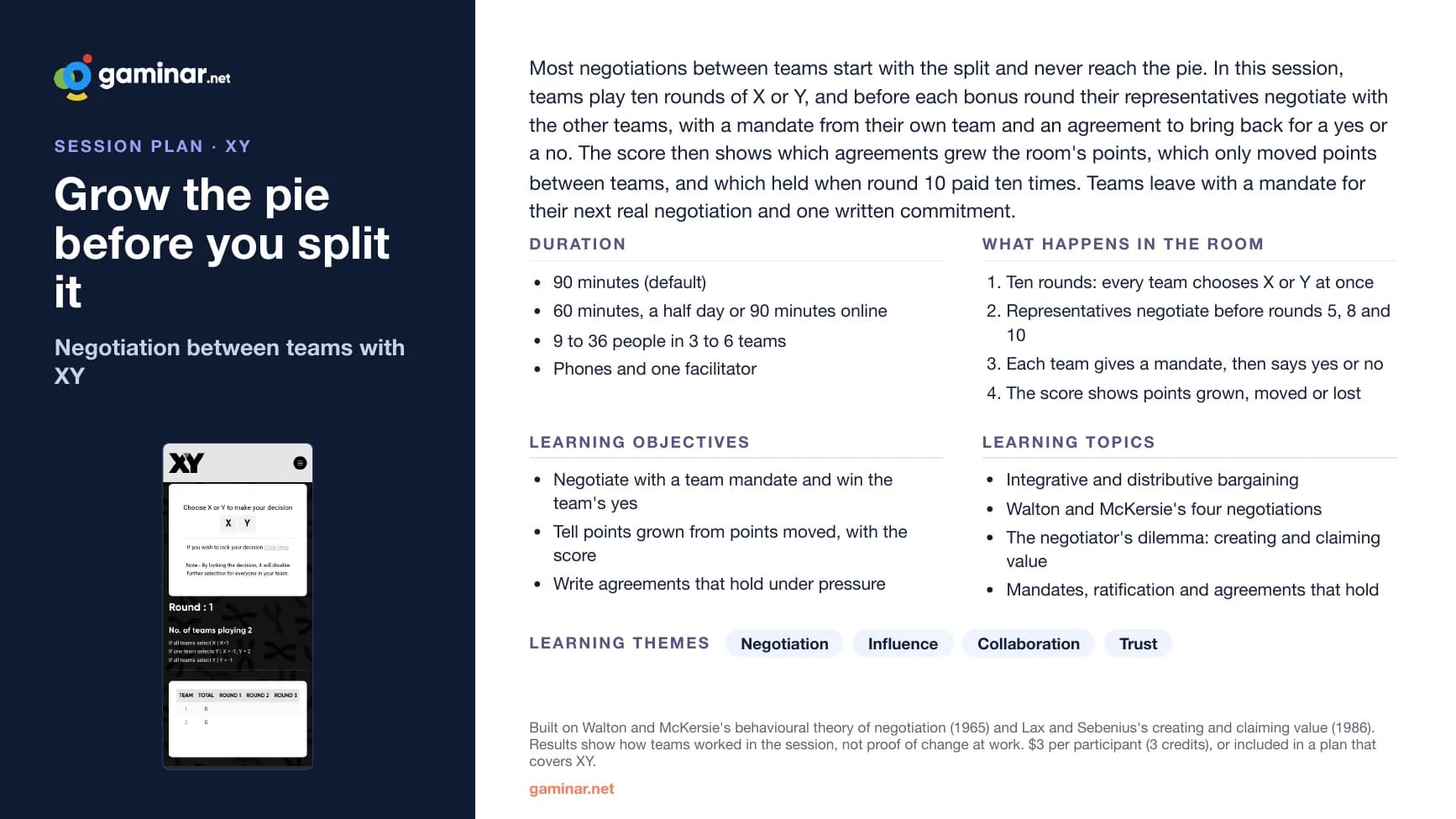
What happens in the session
Most negotiations between teams start with the split and never reach the pie. In this session, teams play ten rounds of X or Y, and before each bonus round their representatives negotiate with the other teams, with a mandate from their own team and an agreement to bring back for a yes or a no. The score then shows which agreements grew the room's points, which only moved points between teams, and which held when round 10 paid ten times. Teams leave with a mandate for their next real negotiation and one written commitment.
A story you will recognise
In a hospital, the emergency department and the surgical wards meet each morning to agree how many beds go to emergency admissions and how many stay free for planned operations. Each representative arrives with a number, defends it, and the meeting ends with whatever the more senior person accepts. On busy days the agreement collapses before noon: emergency parks patients in corridors and surgery cancels operations it had promised to run, because neither team ever agreed to the deal its representative made. This session lets the group practise, in a game, meeting the other side to grow the shared result first, bringing their own team with them, and making agreements that still hold when the pressure peaks.
Who it is for
Managers and specialists who represent their team in meetings with other teams: account and operations managers, budget holders, project steering groups, union and management representatives, partners in a joint venture. Also negotiation and influence modules in leadership programmes.
Use it when
- Representatives come back from meetings with other teams with deals their own team will not back.
- Negotiations between departments (budgets, capacity, dates) start with each side's number and end with whatever the most senior person accepts.
- Agreements between teams hold on a quiet day and collapse at the first peak of pressure.
- A negotiation or influence module needs live practice with real stakes for every team, not role cards.
Pick another plan when
- The negotiation you care about is a one-off with an outside party who wants the opposite and will never meet you again: XY rewards working together over many rounds. Say so instead of playing.
- Anyone in the group has played XY, or another game with an X and Y choice, and cannot be made an observer.
- The problem is broken promises rather than making agreements (Trust is built one round at a time fits better), or teams ranked against each other (Win together, not against each other).
- The group is in open conflict about people rather than about the work. Deal with that first.
Learning objectives
What people leave able to do
- 1
Agree a team mandate before each negotiation, and bring back an agreement the team accepts before anyone locks a choice.
- 2
Sort the ten rounds into points grown, moved or lost, and say which agreements grew the room's points and which only moved them between teams.
- 3
Name the parts of an agreement that made it hold, or break, in rounds 8 and 10, and plan to use one of them in a real negotiation between teams.
The model
Four negotiations in one (Walton and McKersie)
In 1965 Richard Walton and Robert McKersie, studying negotiations between unions and employers, showed that every negotiation is really four processes at once. Distributive bargaining splits a fixed amount: what one side wins, the other loses. Integrative bargaining finds gains for both sides. Attitudinal structuring shapes the relationship, trust or suspicion, that the next negotiation starts from. And intraorganizational bargaining happens inside each side, where a representative has to win their own team's backing. Two decades later David Lax and James Sebenius called the tension between the first two the negotiator's dilemma: the moves that claim value for one side tend to stop both sides from creating it. XY makes all four visible. A round where every team chooses X creates points for the room; a mix only moves points from the X teams to the Y teams; every negotiation leaves the teams more or less trusting; and every representative has to bring the deal home. The four habits below are this session's way of turning their ideas into behaviour you can see in a room; they are not their list.
Grow the pie first
At work: Start with what both teams can gain together, in numbers, before you put your own demand on the table.
Claim in the open, never by surprise
At work: Put your claim on the table and agree the split openly; never take it later by quietly not doing your part.
Write it so it can be checked
At work: End with who does what, by when, how both sides will see it, and what happens if it slips; send it in writing the same day.
Win your own team's yes
At work: Agree your mandate with your team before you meet the other side, and take the deal back to them before you sign.
Source: Richard E. Walton and Robert B. McKersie, 'A Behavioral Theory of Labor Negotiations: An Analysis of a Social Interaction System', McGraw-Hill, 1965; David A. Lax and James K. Sebenius, 'The Manager as Negotiator: Bargaining for Cooperation and Competitive Gain', Free Press, 1986.
The session at a glance
The 90-minute version. The pack has the script for every block.
| Clock | Min | Block |
|---|---|---|
| 0:00 | 4 | Join |
| 0:04 | 4 | Open and prebrief |
| 0:08 | 6 | Briefing |
| 0:14 | 10 | Rounds 1 to 4 |
| 0:24 | 7 | Mandate and negotiation 1 |
| 0:31 | 6 | Rounds 5 to 7 |
| 0:37 | 6 | Mandate and negotiation 2 |
| 0:43 | 5 | Rounds 8 and 9 |
| 0:48 | 5 | Mandate and negotiation 3 |
| 0:53 | 3 | Round 10 |
| 0:56 | 4 | Results |
| 1:00 | 9 | Debrief 1: Feel and What |
| 1:09 | 5 | The model |
| 1:14 | 6 | Grown, moved or lost |
| 1:20 | 4 | Now what |
| 1:24 | 4 | Commitment |
| 1:28 | 2 | Close |
In the full plan
- A minute-by-minute run sheet for 90 minutes, with 60-minute, half-day and online versions
- A script: what to say, what to ask and what to listen for
- The debrief, step by step, and how to carry it back to work
- A one-page handout per participant and an observer sheet
- Slides with speaker notes, and a one-pager to send your client
Word and PowerPoint, so you can make it yours. Read once. 20 minutes of set-up on the day, including the negotiating table, plus one free rehearsal with your phone as team 1 and a private browser window as team 2.
One XY session: 3 credits ($3) per participant who joins, or included in a plan that covers XY (the $175 XY plan, or the Bundle). Observers who do not join cost nothing, and a rehearsal with up to two participants is free. The mandates and agreement cards are on paper and cost nothing. Your first session with a group is free for up to 30 participants.
More with XY
Other session plans on the same game
Collaboration between teams
Win together, not against each other
See the planBuilding trust
Trust is built one round at a time
See the plan
Rehearse it for free before your first real group
Sign up in two minutes, get 100 free credits, and rehearse any game as often as you like: sessions with up to 2 participants are always free.