
Coaching conversations · with Expressive
Coach with a picture
Each person chooses one picture for a real work situation. Then, in groups of three, people take turns to coach, be coached and observe, and practise three habits: open questions, playing back what they heard, and letting the coachee name the next step.
- 60 minutes (default) · 75 minutes · 60 minutes online, in breakout groups of three
- 6 to 30 people in groups of three (one or two groups of four when the numbers do not divide). One facilitator up to about 30; add a second facilitator above that.
Free with every account, 100 credits included. It arrives in the app's Resources on 9 October 2026; sign up now and it is there that morning.
What happens in the session
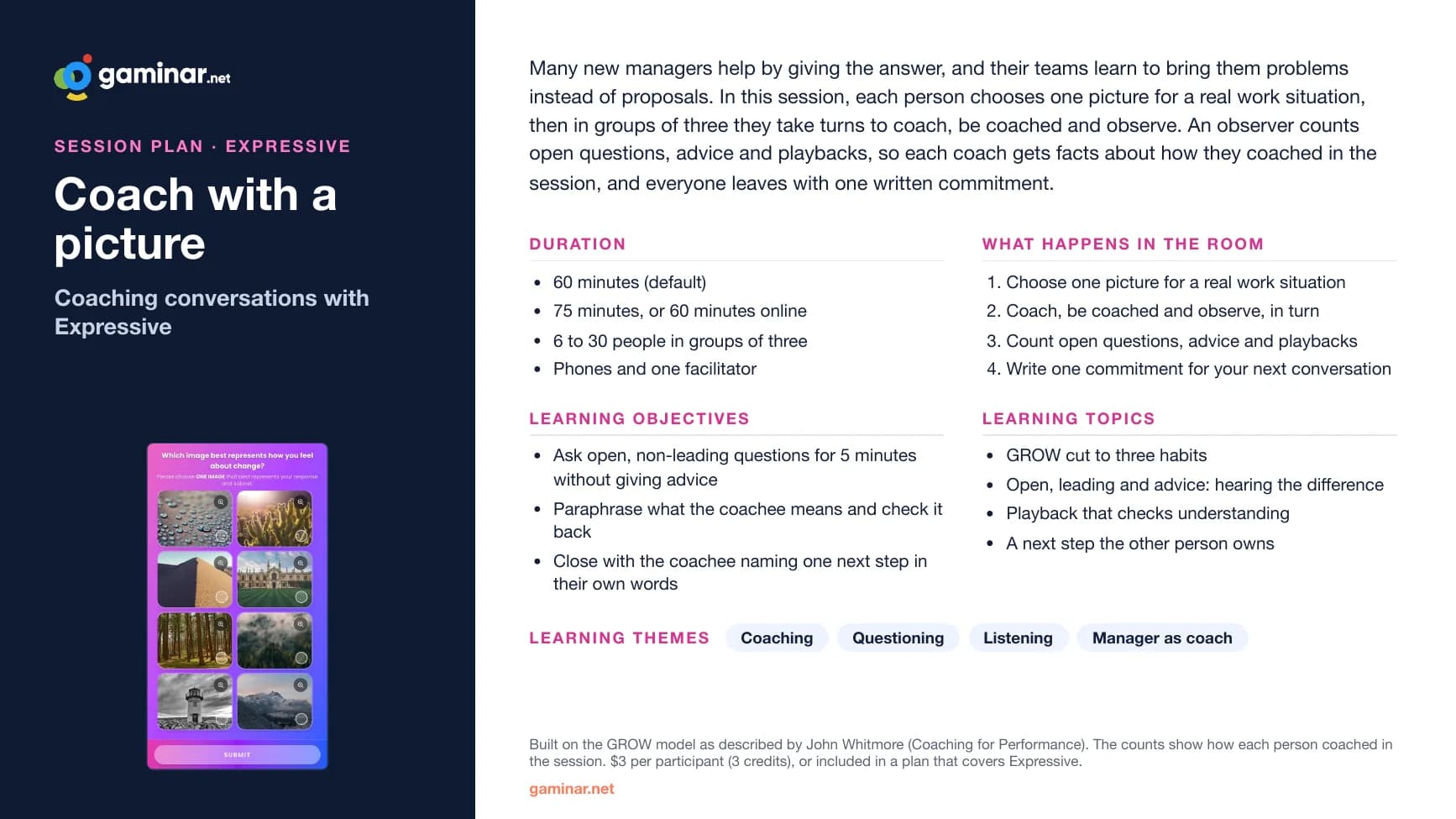
Many new managers help by giving the answer, and their teams learn to bring them problems instead of proposals. In this session, each person chooses one picture for a real work situation, then in groups of three they take turns to coach, be coached and observe. An observer counts open questions, advice and playbacks, so each coach gets facts about how they coached in the session, and everyone leaves with one written commitment.
A story you will recognise
A newly promoted team leader prides herself on being helpful. When a colleague brings her a stuck project, she listens for a minute, then explains what she would do. The colleague thanks her, does it her way, and comes back a week later with the next problem. Six months on, her team brings her problems instead of proposals, and she answers them all herself. This session lets managers practise the alternative in a safe five minutes: ask, play back, and let the other person name the next step.
Who it is for
First-time managers, internal coaches and mentors, HR business partners. Works for anyone whose job includes helping other people think a problem through.
Use it when
- New managers solve their team's problems for them, and their calendars fill up with questions only they can answer.
- An internal coaching or mentoring programme needs a short, practical skill session.
- HR business partners want to ask better questions in their conversations with line managers.
- A leadership programme needs practice, not a lecture, on the manager as coach.
Pick another plan when
- People have no safe topic to bring, for example during redundancies or an investigation. Real topics need some trust.
- The conversation people need is feedback, an instruction or a performance warning. That is not coaching.
- You want an energiser or a get-to-know-you activity. Expressive can do that too, with a different plan; this one is skill practice.
Learning objectives
What people leave able to do
- 1
Ask open, non-leading questions about the coachee's picture for 5 minutes without giving advice.
- 2
Paraphrase what the coachee means and check it back with them.
- 3
Close the conversation with the coachee naming one next step in their own words.
The model
GROW, cut to three habits
GROW (Goal, Reality, Options, Will) is the best-known structure for a coaching conversation, made widely known by John Whitmore's 'Coaching for Performance'. This session cuts it to three habits an observer can count: the open questions carry Goal, Reality and Options, the playback checks that the coach understood the Reality, and the next step is the Will, said by the coachee.
Ask, don't tell
At work: When someone brings you a problem, ask at least two open questions before you offer anything.
Play it back
At work: Before you agree a way forward, sum up the other person's view and ask whether you got it right.
Their next step, their words
At work: End the conversation with the other person saying what they will do and when, in their own words.
Source: John Whitmore, 'Coaching for Performance', Nicholas Brealey Publishing, 1992; fifth edition with Performance Consultants International, 2017. GROW was developed in the 1980s by Graham Alexander, Alan Fine and John Whitmore. The three habits below are this session's simplification, not Whitmore's list.
The session at a glance
The 60-minute version. The pack has the script for every block.
| Clock | Min | Block |
|---|---|---|
| 0:00 | 4 | Join |
| 0:04 | 4 | Open and prebrief |
| 0:08 | 4 | Choose your picture |
| 0:12 | 5 | The model |
| 0:17 | 2 | Groups and roles |
| 0:19 | 8 | Rotation 1: A coaches B |
| 0:27 | 8 | Rotation 2: B coaches C |
| 0:35 | 8 | Rotation 3: C coaches A |
| 0:43 | 7 | Debrief 1: Feel and What |
| 0:50 | 5 | Debrief 2: So what and Now what |
| 0:55 | 3 | Commitment |
| 0:58 | 2 | Close |
In the full plan
- A minute-by-minute run sheet for 90 minutes, with 60-minute, half-day and online versions
- A script: what to say, what to ask and what to listen for
- The debrief, step by step, and how to carry it back to work
- A one-page handout per participant and an observer sheet
- Slides with speaker notes, and a one-pager to send your client
Word and PowerPoint, so you can make it yours. Read once. 15 minutes of set-up on the day, plus one rehearsal on your own phone.
One Expressive session: 3 credits ($3) per participant who joins, or included in a plan that covers Expressive. It is the cheapest Gaminar game to run. The coaching conversations happen without the app and cost nothing more. A later practice in a new session costs 3 credits per participant again, unless a plan covers Expressive. A rehearsal with up to two test participants is free.
More with Expressive
Other session plans on the same game
Empathy
The story behind the picture
See the planSelf-awareness and values
Know what drives you
See the plan
Rehearse it for free before your first real group
Sign up in two minutes, get 100 free credits, and rehearse any game as often as you like: sessions with up to 2 participants are always free.