
Self-awareness and values · with Expressive
Know what drives you
Each person chooses one image for 'What is your top value?', tells a partner why it beat the image they nearly chose, puts the value into one sentence, and leaves with one commitment that puts it into action.
- 60 minutes (default) · 30 minutes, as a module inside a longer programme · 60 minutes online, in breakout pairs
- 4 to 40 people, working in pairs (one group of three when the numbers are odd). One facilitator up to about 30; add a second facilitator above that. One Expressive session takes up to 99 participants.
Free with every account, 100 credits included. It arrives in the app's Resources on 23 October 2026; sign up now and it is there that morning.
What happens in the session
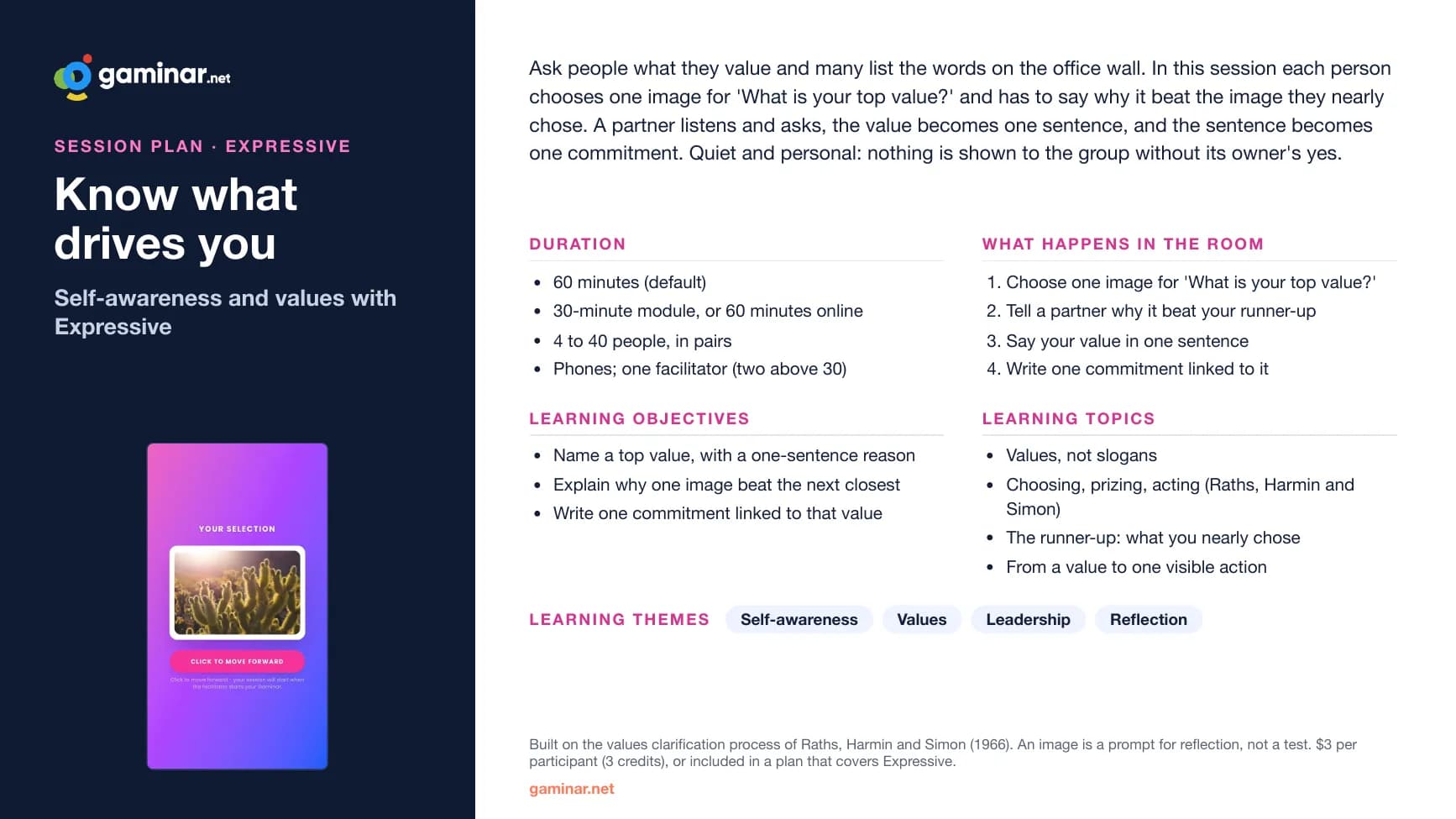
Ask people what they value and many list the words on the office wall. In this session each person chooses one image for 'What is your top value?' and has to say why it beat the image they nearly chose. A partner listens and asks, the value becomes one sentence, and the sentence becomes one commitment. Quiet and personal: nothing is shown to the group without its owner's yes.
A story you will recognise
A newly promoted director is asked, on a leadership programme, what matters most to her at work. She writes integrity, teamwork, excellence and customer focus: the four words on the office wall. Two weeks later she takes on a project that fills every evening, and finds herself short with her team without knowing why. Asked to keep just one thing, she sees that what she protects, and what the project took, is time to develop her people. This session asks people to choose, not to list, and to notice what they nearly chose instead.
Who it is for
Leadership programmes, personal development groups and coaching groups. Works for anyone about to make choices that will test their priorities: a new role, a promotion, a reorganisation.
Use it when
- A leadership programme needs a self-awareness module that ends in something people do, not a personality label.
- Managers face choices that will test their priorities: a new role, a promotion, a reorganisation.
- A coaching or development group is starting and needs a quiet, personal opening that goes beyond introductions.
- People can recite the company values but struggle to say what matters to them.
Pick another plan when
- You want to launch, explain or test the company's values. This session is about personal values, and nothing is reported back.
- Trust is low, for example during redundancies or an investigation. Personal values need a safe room; choose a lighter question.
- You need an energiser or team building. This is a quiet, personal session.
- You want a psychometric profile. An image choice is a prompt for reflection, not a measurement.
Learning objectives
What people leave able to do
- 1
Name their top value in a word or short phrase, with a one-sentence reason drawn from their own work.
- 2
Explain to a partner why they chose their image over the next closest one, their runner-up.
- 3
Write one commitment, linked to that value, for a specific situation in the next two weeks.
The model
Values clarification: choosing, prizing, acting
Raths, Harmin and Simon wrote 'Values and Teaching' in 1966 for teachers who wanted to help people think about their values without preaching to them. Their test: something is a value, rather than an attitude, a belief or an interest (what they called value indicators), when it is chosen freely from alternatives after thinking about the consequences, cherished and affirmed out loud, and acted on, more than once. The session follows those three processes in order: choosing (the image and its runner-up), prizing (one sentence to a partner) and acting (one commitment).
Choose from real alternatives
At work: When you decide where your week goes, name what you are choosing between, not only what you chose.
Weigh the next closest
At work: When two things you care about pull apart, such as speed and quality, say which wins this time and what it costs.
Say it out loud
At work: When you explain a decision, name the value behind it, not only the reasons.
Act on it, then again
At work: Do it where someone could see it, then do it again. A value you never act on is a wish.
Source: Louis E. Raths, Merrill Harmin and Sidney B. Simon, 'Values and Teaching: Working with Values in the Classroom', Columbus, Ohio: Charles E. Merrill Books, 1966; second edition 1978. The four behaviours above are this session's simplification of their seven criteria, not their wording.
The session at a glance
The 60-minute version. The pack has the script for every block.
| Clock | Min | Block |
|---|---|---|
| 0:00 | 4 | Join |
| 0:04 | 5 | Open and prebrief |
| 0:09 | 4 | Connect: a moment that felt right |
| 0:13 | 3 | Briefing |
| 0:16 | 6 | Choose your image |
| 0:22 | 9 | Pairs 1: why this one, not the runner-up |
| 0:31 | 7 | Debrief 1: Feel and What |
| 0:38 | 5 | The model |
| 0:43 | 5 | Pairs 2: say it in one sentence |
| 0:48 | 5 | Debrief 2: So what and Now what |
| 0:53 | 5 | Commitment |
| 0:58 | 2 | Close |
In the full plan
- A minute-by-minute run sheet for 90 minutes, with 60-minute, half-day and online versions
- A script: what to say, what to ask and what to listen for
- The debrief, step by step, and how to carry it back to work
- A one-page handout per participant and an observer sheet
- Slides with speaker notes, and a one-pager to send your client
Word and PowerPoint, so you can make it yours. Read once. 15 minutes of set-up on the day, plus one rehearsal on your own phone.
One Expressive session: 3 credits ($3) per participant who joins, or included in a plan that covers Expressive. The pair work and the handout cost nothing more. Asking the question again in a later session is a new session and costs 3 credits per participant again, unless a plan covers Expressive. A rehearsal with up to two test participants is free.
More with Expressive
Other session plans on the same game
Coaching conversations
Coach with a picture
See the planEmpathy
The story behind the picture
See the plan
Rehearse it for free before your first real group
Sign up in two minutes, get 100 free credits, and rehearse any game as often as you like: sessions with up to 2 participants are always free.