
Empathy · with Expressive
The story behind the picture
Each person's partner writes a guess about what their chosen image means before hearing the real story, the gap between guess and story shows how fast we fill in meaning, and the group practises checking what someone means before acting on it.
- 60 minutes (default) · 30 minutes, as a module inside a longer programme · 60 minutes online, in breakout pairs
- 6 to 30 people, working in pairs (one group of three when the numbers are odd), with pairs joining into fours once. One facilitator up to about 30; add a second facilitator above that. One Expressive session takes up to 99 participants.
Free with every account, 100 credits included. It arrives in the app's Resources on 16 October 2026; sign up now and it is there that morning.
What happens in the session
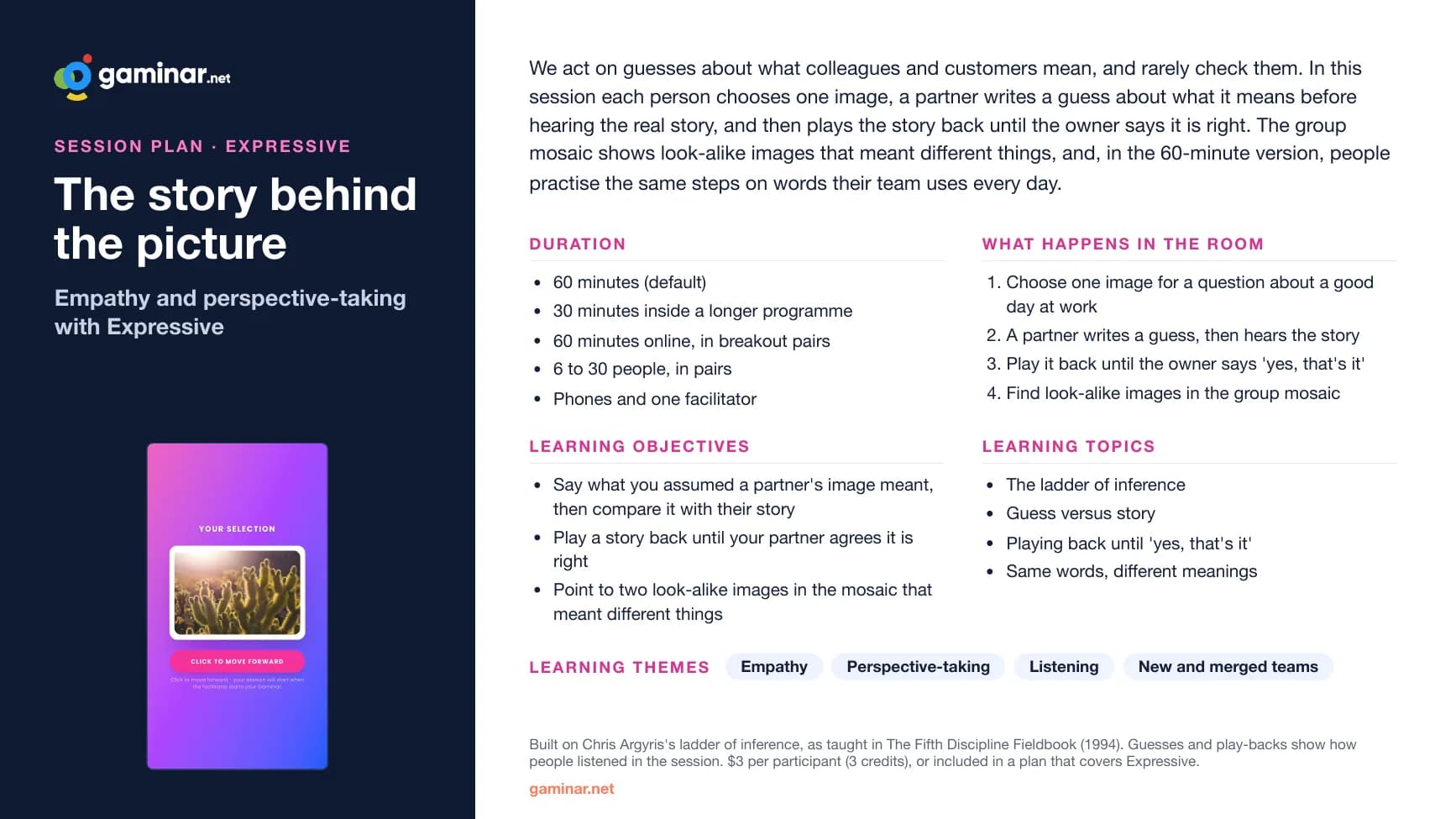
We act on guesses about what colleagues and customers mean, and rarely check them. In this session each person chooses one image, a partner writes a guess about what it means before hearing the real story, and then plays the story back until the owner says it is right. The group mosaic shows look-alike images that meant different things, and, in the 60-minute version, people practise the same steps on words their team uses every day.
A story you will recognise
Two support teams merge after an acquisition. In the first month, a team leader from one side ends every request with 'when you get a chance'. To her it means 'today, please'; to her new colleagues it means 'whenever', and three customer replies slip. She decides they are not committed, and they decide she is vague, and nobody asks what the other meant. This session lets people see that pattern in a picture, where it costs nothing, and practise checking what someone means before acting on the guess.
Who it is for
New, merged or diverse teams, and customer-facing staff. Works for any group where people read each other's requests, emails or reactions and act on a guess about what was meant.
Use it when
- A new or merged team acts on guesses about what colleagues mean, and small misunderstandings are turning into opinions about people.
- A diverse team needs a low-risk way to see that the same picture, word or request can mean different things to different people.
- Customer-facing staff need to practise checking what someone means before they answer.
- A programme needs a short, practical empathy module with practice in it, not a lecture.
Pick another plan when
- Trust is low, for example during redundancies or an investigation. Every image is shown to the group with its owner's name.
- Two people are in open conflict and need it resolved. This is practice, not mediation.
- You only need a quick icebreaker. This session asks people to listen closely for most of an hour.
- You want to measure or assess empathy. A guess and a play-back are practice, not a test.
Learning objectives
What people leave able to do
- 1
Say what they assumed a partner's image meant, then compare that guess with the partner's own story.
- 2
Paraphrase a partner's story until the partner agrees it is right.
- 3
Point to two similar images in the group mosaic that carried different meanings for their owners.
The model
The ladder of inference
Chris Argyris noticed that people climb in seconds from what they actually saw or heard to a conclusion about what it means, without noticing the steps, and then act on the conclusion as if it were a fact. The Fifth Discipline Fieldbook turned the ladder into a tool teams can use. This session uses three steps of it: what I saw, what I assumed, and what it meant to them. The only way to the third step is to ask the person, and to check your answer with them until they say it is right.
Start with what you saw
At work: Before you react to an email or a request, say to yourself what was actually written or done.
Say your guess as a guess
At work: Say 'I took that to mean ___. Is that what you meant?' instead of acting on it.
Ask what it means to them
At work: Ask one open question about what matters to them, then listen to the end of the answer.
Play it back until they say yes
At work: Before you answer a customer or a colleague, play back what they need and wait for their yes.
Source: The ladder is Chris Argyris's: Chris Argyris, Robert Putnam and Diana McLain Smith, 'Action Science', San Francisco: Jossey-Bass, 1985. It was made a team tool by Rick Ross, 'The Ladder of Inference', in Peter M. Senge, Art Kleiner, Charlotte Roberts, Richard B. Ross and Bryan J. Smith, 'The Fifth Discipline Fieldbook', New York: Currency Doubleday, 1994. The three steps used here (what I saw, what I assumed, what it meant to them) are this session's simplification, not the original rungs.
The session at a glance
The 60-minute version. The pack has the script for every block.
| Clock | Min | Block |
|---|---|---|
| 0:00 | 4 | Join |
| 0:04 | 5 | Open and prebrief |
| 0:09 | 3 | Briefing |
| 0:12 | 5 | Choose your image |
| 0:17 | 10 | Pairs: guess, story, play back |
| 0:27 | 6 | Mosaic: same picture, different story |
| 0:33 | 5 | Debrief 1: Feel and What |
| 0:38 | 5 | The model |
| 0:43 | 6 | Round 2: work words |
| 0:49 | 5 | Debrief 2: So what and Now what |
| 0:54 | 4 | Commitment |
| 0:58 | 2 | Close |
In the full plan
- A minute-by-minute run sheet for 90 minutes, with 60-minute, half-day and online versions
- A script: what to say, what to ask and what to listen for
- The debrief, step by step, and how to carry it back to work
- A one-page handout per participant and an observer sheet
- Slides with speaker notes, and a one-pager to send your client
Word and PowerPoint, so you can make it yours. Read once. 15 minutes of set-up on the day, plus one free rehearsal (press Practice on Expressive in your account) with your own phone and a private browser window.
One Expressive session: 3 credits ($3) per participant who joins, or included in a plan that covers Expressive. The pair work and round 2 are on paper and cost nothing more. Running it again with the same group is a new session and costs 3 credits per participant again, unless a plan covers Expressive. A rehearsal with your phone and one private browser window is free: the first two participants of every session cost nothing.
More with Expressive
Other session plans on the same game
Coaching conversations
Coach with a picture
See the planSelf-awareness and values
Know what drives you
See the plan
Rehearse it for free before your first real group
Sign up in two minutes, get 100 free credits, and rehearse any game as often as you like: sessions with up to 2 participants are always free.