
Active listening · with Unlock
Listen until you can see it
Teams put a sequence of pictures in order when nobody can see anyone else's pictures, find out from their own wrong attempts where listening broke down, and practise a four-step check-back loop in rounds 2 and 3, the last one under time pressure.
- 90 minutes, three rounds (default) · 45 minutes, two rounds · 60 minutes online · Half day
- 4 to 60 people in teams of 4 to 6, at most 10 teams: Unlock accepts team numbers 1 to 10. One facilitator up to about 30 people; above that, add one observer per team.
Free with every account, 100 credits included. In the app since 2 October 2026.
What happens in the session
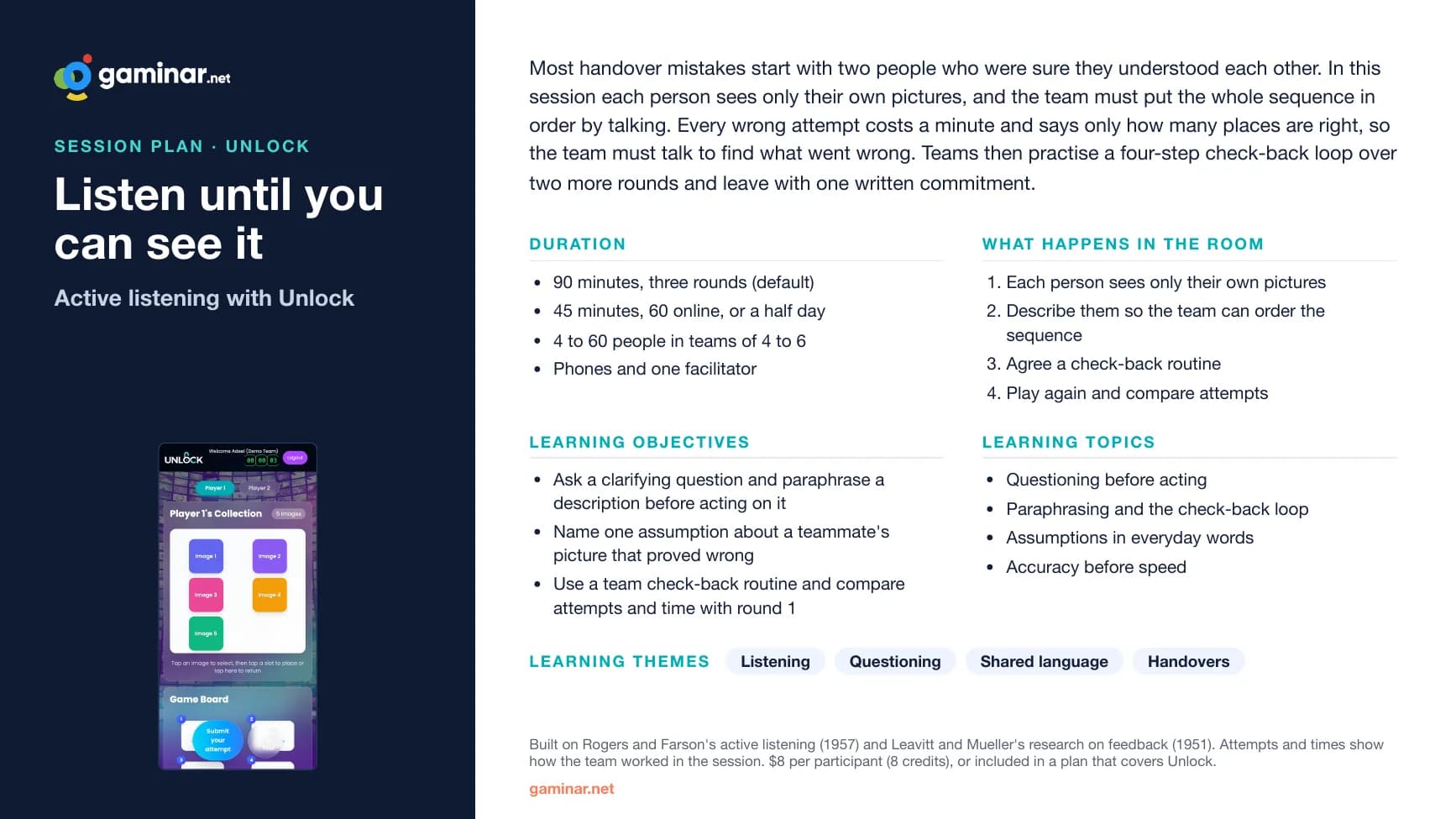
Most handover mistakes start with two people who were sure they understood each other. In this session each person sees only their own pictures, and the team must put the whole sequence in order by talking. Every wrong attempt costs a minute and says only how many places are right, so the team must talk to find what went wrong. Teams then practise a four-step check-back loop over two more rounds and leave with one written commitment.
A story you will recognise
A support team works in two shifts. Every evening, open customer cases are handed over in a five-minute call. Last month a refund was paid twice: the evening agent said 'the refund is done', meaning approved, and the morning agent heard paid and paid it again. Both were sure they had understood. Nobody asked a question and nobody said back what they had heard. This session lets the team find that gap in a game, where a wrong guess costs one minute, and practise the check-back before the next handover.
Who it is for
Communication courses, customer service teams, jobs with many handovers (shifts, projects, support levels), and new teams at their kick-off.
Use it when
- Work keeps going wrong at handovers, and the post-mortem always contains 'I thought you meant...'.
- A customer service team needs to practise questioning and paraphrasing with evidence from the room, not role play.
- A communication course needs a live exercise where listening visibly changes a result.
- A new team needs one shared habit for checking understanding before the real work starts.
Pick another plan when
- You need a module on conflict or leadership. This session does not cover them.
- The group is in open conflict about people rather than about the work. Deal with that first.
- You want to compare individuals. Unlock scores teams, not people.
- Some people cannot use a phone or see small pictures. Use the describe-and-draw fallback in Appendix D for everyone.
Learning objectives
What people leave able to do
- 1
Before an image is placed, ask its holder one clarifying question and paraphrase their description, in rounds 2 and 3.
- 2
Name one assumption about a teammate's image that proved wrong, and the words that caused it.
- 3
In round 2, use the team's agreed check-back routine, then compare the team's attempts and time with round 1 and say how much of the change was memory.
The model
The check-back loop
In 1951 Leavitt and Mueller had one person describe a drawing to others who copied it. When the listeners could ask questions and check back, the copies were more accurate, though it took longer. Rogers and Farson called the listening side active listening; hospitals now teach the same loop as the check-back, and pilots as the read-back. Four steps you can hear in the room.
Describe
At work: Give the whole situation first, then the detail the other person needs to act on.
Ask
At work: Ask one question before you act on what you heard: 'Done as in approved, or done as in paid?'
Paraphrase
At work: Say back the next step in your own words: 'So I pay it tomorrow, after the approval arrives?'
Confirm, then act
At work: Wait for a clear yes, or a correction, before you move on or hang up.
Source: Carl Rogers and Richard Farson, 'Active Listening', University of Chicago Industrial Relations Center, 1957; Harold Leavitt and Ronald Mueller, 'Some effects of feedback on communication', Human Relations, 1951; the check-back in TeamSTEPPS, US Agency for Healthcare Research and Quality and Department of Defense, 2006.
The session at a glance
The 90-minute version. The pack has the script for every block.
| Clock | Min | Block |
|---|---|---|
| 0:00 | 5 | Join |
| 0:05 | 5 | Open and prebrief |
| 0:10 | 3 | Connect |
| 0:13 | 5 | Briefing |
| 0:18 | 12 | Round 1 |
| 0:30 | 3 | Round 1 results |
| 0:33 | 8 | Debrief 1: Feel and What |
| 0:41 | 5 | The model |
| 0:46 | 5 | Team routine |
| 0:51 | 9 | Round 2 |
| 1:00 | 3 | Round 2 results |
| 1:03 | 6 | Debrief 2: So what |
| 1:09 | 7 | Round 3: under pressure |
| 1:16 | 3 | Three rounds side by side |
| 1:19 | 4 | Now what |
| 1:23 | 5 | Commitment |
| 1:28 | 2 | Close |
In the full plan
- A minute-by-minute run sheet for 90 minutes, with 60-minute, half-day and online versions
- A script: what to say, what to ask and what to listen for
- The debrief, step by step, and how to carry it back to work
- A one-page handout per participant and an observer sheet
- Slides with speaker notes, and a one-pager to send your client
Word and PowerPoint, so you can make it yours. Read once. 20 minutes of set-up on the day, plus one rehearsal with two phones.
One Unlock session: 8 credits ($8) per participant who joins, or included in a plan that covers Unlock. All the rounds of one session are one session, so rounds 2 and 3 cost nothing extra. Observers who do not join cost nothing. A second Unlock session, for example a booster weeks later, costs 8 credits per participant again, unless a plan covers Unlock.
More with Unlock
Other session plans on the same game
Clear communication
Say it so they can see it
See the planContinuous improvement
Get faster every round
See the plan
Rehearse it for free before your first real group
Sign up in two minutes, get 100 free credits, and rehearse any game as often as you like: sessions with up to 2 participants are always free.