
Clear communication · with Unlock
Say it so they can see it
Teams put a sequence of images in order when each person sees only their own, work back from their wrong attempts to the descriptions that were misunderstood, and practise four habits of a clear description over three rounds, then on a real briefing of their own.
- 90 minutes, three rounds (default) · 60 minutes, two rounds · 60 minutes online · Half day
- 8 to 60 people in teams of 4 to 6, at most 10 teams: Unlock accepts team numbers 1 to 10. One facilitator up to about 30 people; above that, add one observer per team.
Free with every account, 100 credits included. It arrives in the app's Resources on 9 October 2026; sign up now and it is there that morning.
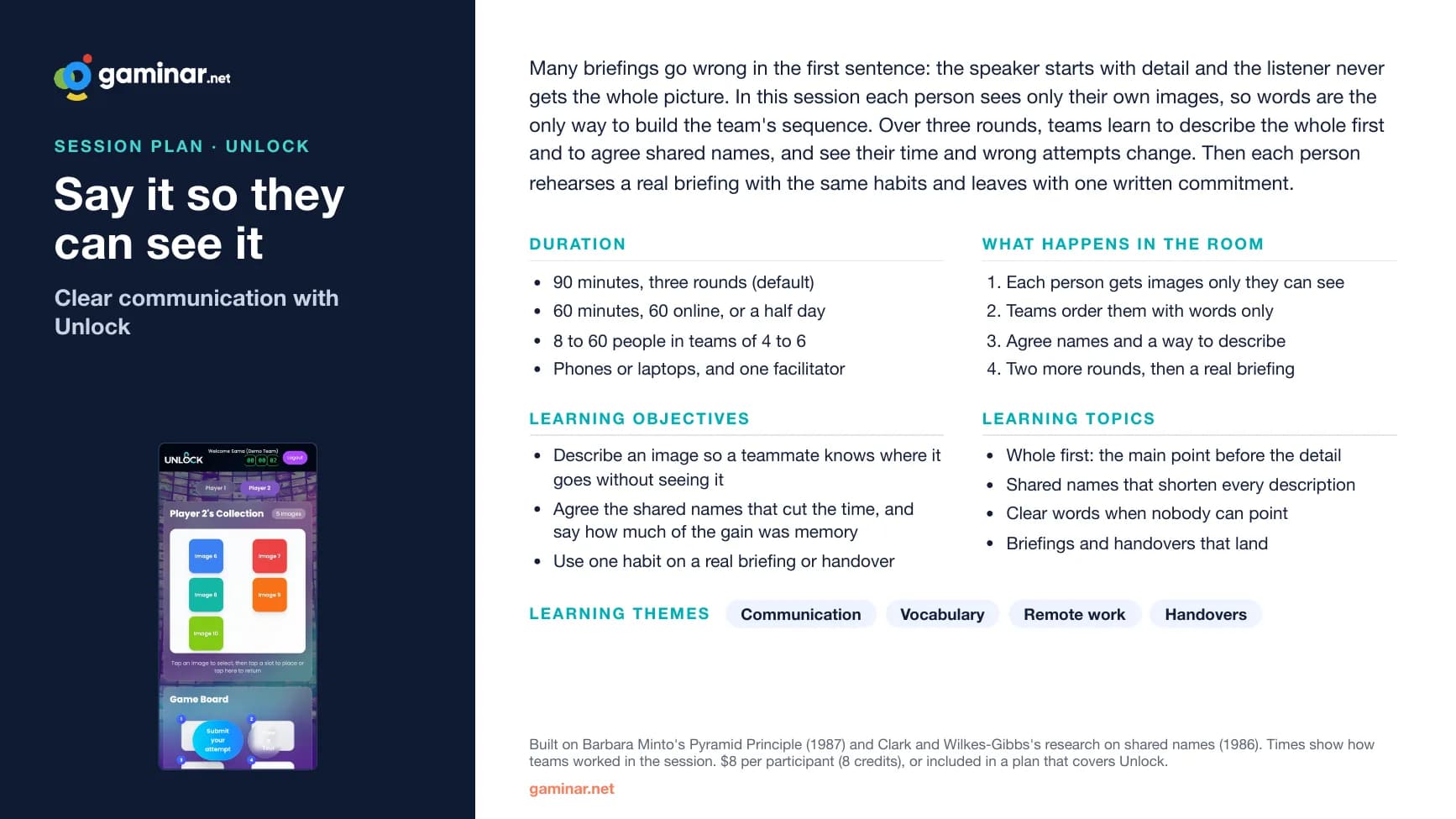
What happens in the session
Many briefings go wrong in the first sentence: the speaker starts with detail and the listener never gets the whole picture. In this session each person sees only their own images, so words are the only way to build the team's sequence. Over three rounds, teams learn to describe the whole first and to agree shared names, and see their time and wrong attempts change. Then each person rehearses a real briefing with the same habits and leaves with one written commitment.
A story you will recognise
A project lead briefs a supplier on a video call about a change to a product launch. She starts with the details she has lived with for weeks: two new dates, three part numbers, a meeting that moved. The supplier repeats it back as a delay; it was in fact a change of scope, and 'the launch kit' meant something different on each side of the call. Every word was correct, but she never said the one sentence that made sense of the rest. This session lets a team find that gap in a game, where a wrong guess costs one minute, and practise the fix before the next briefing.
Who it is for
Team leaders, cross-functional and onboarding groups, remote and hybrid teams. Works for anyone who briefs, instructs or hands over work.
Use it when
- Briefings, handovers or instructions keep being 'understood' and then done differently.
- A remote or hybrid team works mostly on calls, where nobody can point at anything.
- A cross-functional or onboarding group uses one word for different things, or different words for one thing.
- A team leader programme needs a module on giving clear instructions, with evidence from the room, not a lecture.
Pick another plan when
- Listening and questioning are the main skill you need. Use the sister pack, Listen until you can see it.
- The group is in open conflict about people rather than about the work. Deal with that first.
- You want to compare individuals. Unlock scores teams, not people.
- Some people cannot use a phone or see small pictures. Run the describe-and-draw fallback in the appendices for everyone.
Learning objectives
What people leave able to do
- 1
In rounds 2 and 3, describe one of your images, whole first, well enough that a teammate can say which slot it goes in without seeing it.
- 2
Agree names for the images with your team between rounds, then name the two or three words that cut the time and say how much of the gain was memory.
- 3
Rehearse a real briefing or handover with one of the four habits, and write it as a commitment for a named moment in the next two weeks.
The model
Four habits of a clear description
Barbara Minto's Pyramid Principle says a clear message puts the main point first and the supporting points after it, in a logical order. Applied to a picture, that gives the first three habits: the whole, then where it sits, then the one detail that tells it apart. The fourth comes from Clark and Wilkes-Gibbs: pairs who described the same figures to each other round after round, without seeing each other's, made their descriptions much shorter by agreeing names for them.
Whole first
At work: Open a briefing with the point in one sentence: 'The client says yes, with one condition.' Then the detail.
Then where it sits
At work: Say where this fits: which project, which step, what came before it and what comes next.
One detail that tells it apart
At work: Name the one fact that makes this case different from the usual one, instead of listing every fact.
Name it, then use the name
At work: Use the words your listener already uses. With someone who was not there when a name was agreed, give the long version first.
Source: Barbara Minto, 'The Pyramid Principle: Logic in Writing and Thinking', London: Pitman, 1987; Herbert H. Clark and Deanna Wilkes-Gibbs, 'Referring as a collaborative process', Cognition, 22, 1986, pages 1 to 39.
The session at a glance
The 90-minute version. The pack has the script for every block.
| Clock | Min | Block |
|---|---|---|
| 0:00 | 5 | Join |
| 0:05 | 5 | Open and prebrief |
| 0:10 | 3 | Connect |
| 0:13 | 4 | Briefing |
| 0:17 | 12 | Round 1 |
| 0:29 | 2 | Round 1 results |
| 0:31 | 8 | Debrief 1: Feel and What |
| 0:39 | 6 | The model |
| 0:45 | 4 | Team huddle: names |
| 0:49 | 10 | Round 2 |
| 0:59 | 4 | Round 2 review |
| 1:03 | 8 | Round 3 |
| 1:11 | 3 | Results |
| 1:14 | 5 | Debrief 2: So what |
| 1:19 | 6 | Now what: the real briefing |
| 1:25 | 3 | Commitment |
| 1:28 | 2 | Close |
In the full plan
- A minute-by-minute run sheet for 90 minutes, with 60-minute, half-day and online versions
- A script: what to say, what to ask and what to listen for
- The debrief, step by step, and how to carry it back to work
- A one-page handout per participant and an observer sheet
- Slides with speaker notes, and a one-pager to send your client
Word and PowerPoint, so you can make it yours. Read once. 20 minutes of set-up on the day, plus one rehearsal with two phones.
One Unlock session: 8 credits ($8) per participant who joins, or included in a plan that covers Unlock. All the rounds of one session are one session, so rounds 2 and 3 cost nothing extra. Observers who do not join cost nothing. A second Unlock session, for example a booster on a new image set weeks later, costs 8 credits per participant again, unless a plan covers Unlock.
More with Unlock
Other session plans on the same game
Active listening
Listen until you can see it
See the planContinuous improvement
Get faster every round
See the plan
Rehearse it for free before your first real group
Sign up in two minutes, get 100 free credits, and rehearse any game as often as you like: sessions with up to 2 participants are always free.