
Continuous improvement · with Unlock
Get faster every round
Teams play the same Unlock puzzle four times, hold a two-minute plan, do, check, act review between rounds, and explain their own improvement curve in terms of the changes they made, separating what they changed from what they simply remembered.
- 90 minutes, four rounds (default) · 60 minutes, three rounds · 75 minutes online, three rounds · Half day, six rounds and a real process
- 8 to 60 people in teams of 4 to 6, at most 10 teams: Unlock accepts team numbers 1 to 10. One facilitator up to about 30 people; above that, add one observer per team.
Free with every account, 100 credits included. It arrives in the app's Resources on 23 October 2026; sign up now and it is there that morning.
What happens in the session
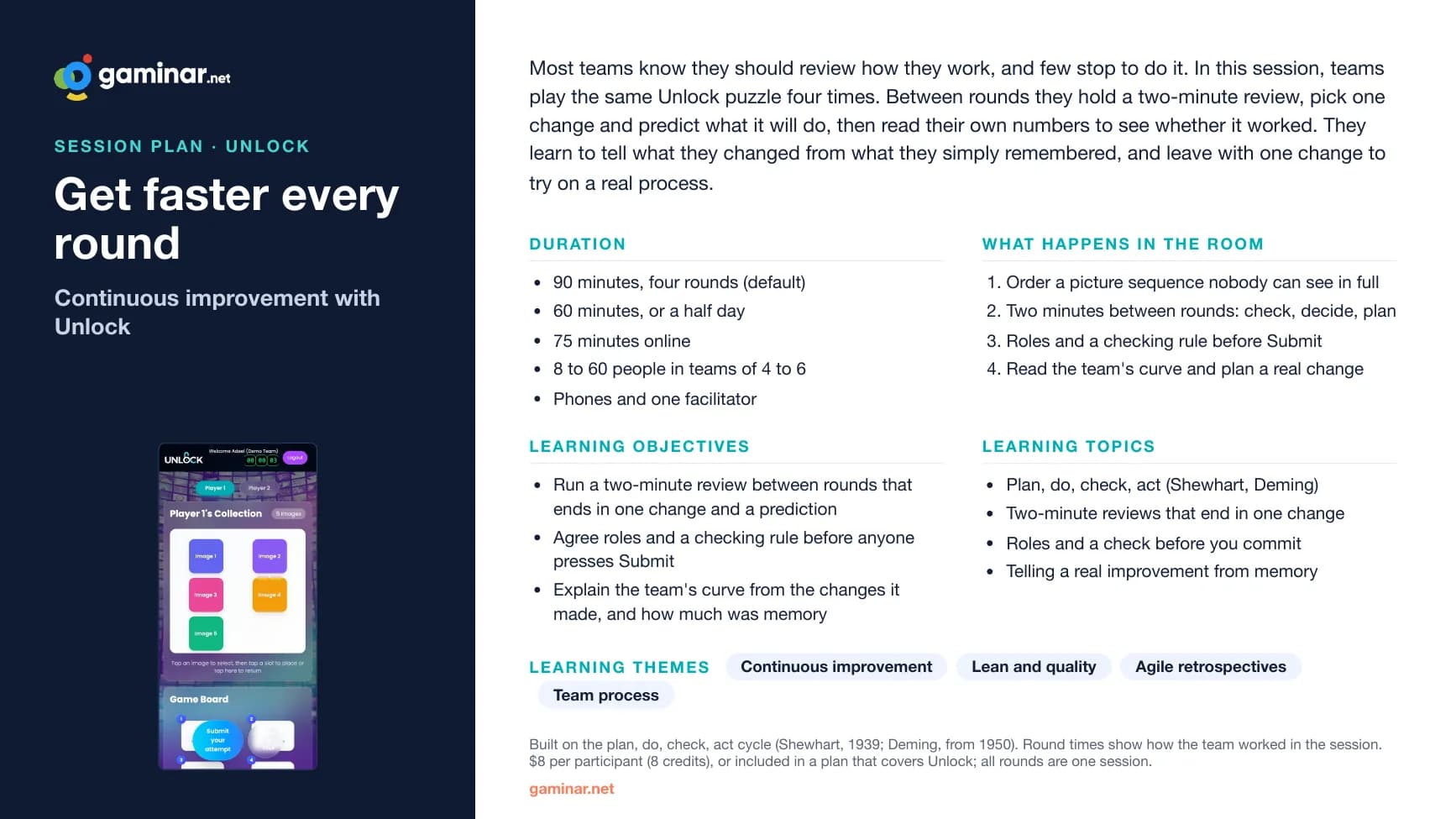
Most teams know they should review how they work, and few stop to do it. In this session, teams play the same Unlock puzzle four times. Between rounds they hold a two-minute review, pick one change and predict what it will do, then read their own numbers to see whether it worked. They learn to tell what they changed from what they simply remembered, and leave with one change to try on a real process.
A story you will recognise
An operations team builds the same performance report every Monday. It takes most of the morning, and most weeks something is wrong: a figure from the wrong week, a chart nobody updated. Everyone agrees it should be faster, and every week they promise to be more careful. Nobody stops to ask what exactly slowed them down, picks one thing to change, and checks the next Monday whether it worked. This session lets the team run that loop three times in an hour, where a wrong attempt costs one minute, and then plan the first loop on the real report.
Who it is for
Operations, lean and quality teams, project teams, and agile teams that want better retrospectives. Works for any team that runs the same process again and again.
Use it when
- A team runs the same process every week and never stops to ask how it went.
- Retrospectives or lessons-learned meetings produce long lists and no change anyone can point to.
- A lean, quality or agile programme needs a live plan, do, check, act cycle that the group runs itself, on its own numbers.
- A project team needs to agree roles and a 'check before you commit' rule before the work speeds up.
Pick another plan when
- The skill you need is listening or describing. Use the sister packs Listen until you can see it, or Say it so they can see it.
- The process is blocked by a tool, budget or policy the team cannot change. Fix that first, or bring in the people who own it.
- The group is in open conflict about people rather than about the work. Deal with that first.
- You want to compare individuals. Unlock scores teams, not people.
Learning objectives
What people leave able to do
- 1
Run a two-minute review between rounds that ends with one change to try and a prediction, written in the team's change log.
- 2
Before round 2, assign roles in the team and state one checking rule that must be met before anyone presses Submit.
- 3
Explain the team's trend over the rounds in terms of the changes it made, and say which part of the gain was simply memory.
The model
Plan, do, check, act
In 1939 Walter Shewhart described quality control as a cycle, not a straight line: specify, produce, inspect, then go round again. W. Edwards Deming taught the cycle in Japan from 1950, where it became plan, do, check, act; later he preferred 'study' to 'check', to stress learning over inspecting. The idea is small and testable: one change at a time, a prediction, a look at the numbers, and a decision. Four steps you can see in a two-minute review.
Plan: one change and a prediction
At work: Before changing a process, write down the one change and what you expect to see, and by when.
Do: run it as agreed
At work: Try the change as agreed, small and for long enough to see an effect, before judging it.
Check: the numbers against the prediction
At work: Look at the numbers before the opinions, and compare them with the prediction, not with your hopes.
Act: keep, adjust or drop
At work: Make what worked the new standard and write it down; drop what did not, without blame; pick the next change.
Source: Walter A. Shewhart, 'Statistical Method from the Viewpoint of Quality Control', Graduate School of the US Department of Agriculture, 1939, with the editorial assistance of W. Edwards Deming; W. Edwards Deming, 'Out of the Crisis', MIT Press, 1986, and 'The New Economics', MIT Press, 1993, where he calls it plan, do, study, act; Ronald Moen and Clifford Norman, 'Circling back', Quality Progress, November 2010, a history of the cycle.
The session at a glance
The 90-minute version. The pack has the script for every block.
| Clock | Min | Block |
|---|---|---|
| 0:00 | 5 | Join |
| 0:05 | 5 | Open and prebrief |
| 0:10 | 5 | Briefing |
| 0:15 | 11 | Round 1: as you like |
| 0:26 | 2 | Round 1 results |
| 0:28 | 6 | Debrief 1: Feel and What |
| 0:34 | 5 | The model |
| 0:39 | 5 | Plan: roles and a checking rule |
| 0:44 | 8 | Round 2 |
| 0:52 | 4 | Review after round 2 |
| 0:56 | 7 | Round 3 |
| 1:03 | 4 | Review after round 3 |
| 1:07 | 6 | Round 4 |
| 1:13 | 3 | Round by round |
| 1:16 | 6 | Debrief 2: So what |
| 1:22 | 3 | Now what |
| 1:25 | 3 | Commitment |
| 1:28 | 2 | Close |
In the full plan
- A minute-by-minute run sheet for 90 minutes, with 60-minute, half-day and online versions
- A script: what to say, what to ask and what to listen for
- The debrief, step by step, and how to carry it back to work
- A one-page handout per participant and an observer sheet
- Slides with speaker notes, and a one-pager to send your client
Word and PowerPoint, so you can make it yours. Read once. 20 minutes of set-up on the day, plus one rehearsal with two phones.
One Unlock session: 8 credits ($8) per participant who joins, or included in a plan that covers Unlock. All the rounds of one session are one session, so rounds 2 to 4 (or 2 to 6 in the half day) cost nothing extra. Observers who do not join cost nothing. A second Unlock session, for example a booster weeks later, costs 8 credits per participant again, unless a plan covers Unlock.
More with Unlock
Other session plans on the same game
Active listening
Listen until you can see it
See the planClear communication
Say it so they can see it
See the plan
Rehearse it for free before your first real group
Sign up in two minutes, get 100 free credits, and rehearse any game as often as you like: sessions with up to 2 participants are always free.