
Consensus decisions · with Ranking
Decide better together than alone
Teams rank a survival scenario alone and then together, see from their own scores whether the team did better than its members, and practise four habits that help a team decide better than its average member.
- 60 minutes · 90 minutes (default) · Half day · 75 minutes online
- 8 to 40 people in teams of 4 to 8. One facilitator up to about 24 people; add observers above that.
Free with every account, 100 credits included. In the app since 2 October 2026.
What happens in the session
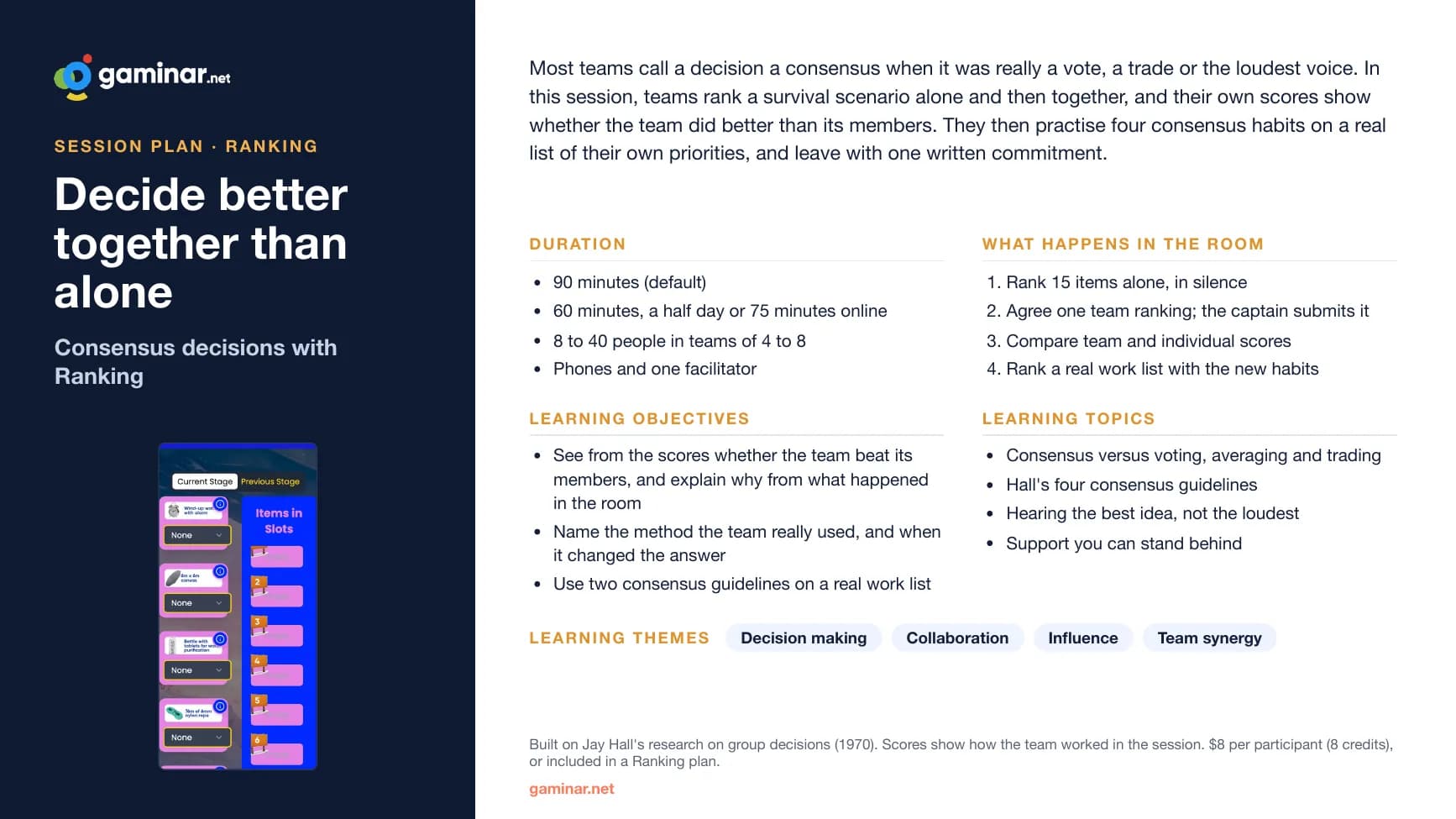
Most teams call a decision a consensus when it was really a vote, a trade or the loudest voice. In this session, teams rank a survival scenario alone and then together, and their own scores show whether the team did better than its members. They then practise four consensus habits on a real list of their own priorities, and leave with one written commitment.
A story you will recognise
A regional leadership team spends two meetings choosing which five of twelve projects to fund. The discussion is polite. In the end the director suggests a quick vote, the list passes eight to three, and everyone calls it a consensus. A month later two of the funded projects stall, because the three who were outvoted never believed in them and one of them had known why. This session lets the team see that pattern in a game, where it costs nothing, and practise the alternative before the next real list.
Who it is for
Intact teams, and management or leadership programmes. Works for any group that makes decisions together: project teams, leadership teams, committees.
Use it when
- A team keeps making decisions that nobody fully backs a week later.
- Meetings end in a vote, a trade or the most senior person's view, and people call it agreement.
- A leadership programme needs a module on joint decisions with evidence from the room, not a lecture.
- A new team needs to agree how it will decide before the big decisions arrive.
Pick another plan when
- The decision is an emergency, or clearly belongs to one accountable person.
- The group is in open conflict about people rather than about the task. Deal with that first.
- You need to rank real business priorities with the full facts. Use round 2 for that, not the game.
Learning objectives
What people leave able to do
- 1
Produce a team ranking and explain, from what happened in the room, why the team did or did not do better than its members.
- 2
Name the method the team actually used (argument, vote, averaging, trading or status) and one moment where it changed the answer.
- 3
Use two of Hall's consensus guidelines on a real work list in round 2, and compare how the decision was reached with round 1.
The model
Hall's consensus guidelines
Hall ran the same survival ranking design you just played. Groups given a short set of guidelines before the discussion did better than groups left to their own devices. Four of them are behaviours you can see in the room.
State, then listen
At work: Put your position and your reason on the table, then invite the counter-view in the same breath.
No shortcuts
At work: When someone says 'let's just vote', ask what we still disagree about and why.
Move for a reason, not for peace
At work: Say 'I am persuaded because...' or 'I can live with it, but I am not convinced', out loud.
Treat disagreement as information
At work: Ask the quiet or the dissenting person what they know that the rest of us do not.
Source: Jay Hall and W. H. Watson, 'The effects of a normative intervention on group decision-making performance', Human Relations, 1970; Jay Hall, 'Decisions, Decisions, Decisions', Psychology Today, 1971.
The session at a glance
The 90-minute version. The pack has the script for every block.
| Clock | Min | Block |
|---|---|---|
| 0:00 | 5 | Join |
| 0:05 | 5 | Open and prebrief |
| 0:10 | 3 | Connect |
| 0:13 | 4 | Briefing |
| 0:17 | 8 | Stage 1: alone |
| 0:25 | 12 | Stage 2: as a team |
| 0:37 | 3 | Results |
| 0:40 | 10 | Debrief 1: Feel and What |
| 0:50 | 7 | The model |
| 0:57 | 3 | Team agreement |
| 1:00 | 13 | Round 2: the real list |
| 1:13 | 10 | Debrief 2: So what and Now what |
| 1:23 | 5 | Commitment |
| 1:28 | 2 | Close |
In the full plan
- A minute-by-minute run sheet for 90 minutes, with 60-minute, half-day and online versions
- A script: what to say, what to ask and what to listen for
- The debrief, step by step, and how to carry it back to work
- A one-page handout per participant and an observer sheet
- Slides with speaker notes, and a one-pager to send your client
Word and PowerPoint, so you can make it yours. Read once. 20 minutes of set-up on the day, plus one rehearsal on your own phone.
One Ranking session: 8 credits ($8) per participant who joins, or included in a plan that covers Ranking. Round 2 is on paper and costs nothing. A second scored scenario is a second session and costs 8 credits per participant again, unless a Ranking plan covers it.
More with Ranking
Other session plans on the same game
Influence without authority
Get the best idea heard
See the planConstructive disagreement
Disagree to decide better
See the plan
Rehearse it for free before your first real group
Sign up in two minutes, get 100 free credits, and rehearse any game as often as you like: sessions with up to 2 participants are always free.