
Influence without authority · with Ranking
Get the best idea heard
Teams rank a survival scenario alone and then together, use the leaderboard to find whose ranking came closest in each team, check against their own notes whether it was heard, and practise balancing advocacy and inquiry on a real decision where the person holding the pen has the least authority.
- 90 minutes (default) · 60 minutes · 75 minutes online
- 8 to 40 people in teams of 4 to 8. One facilitator up to about 24 people; add one observer per team above that.
Free with every account, 100 credits included. It arrives in the app's Resources on 9 October 2026; sign up now and it is there that morning.
What happens in the session
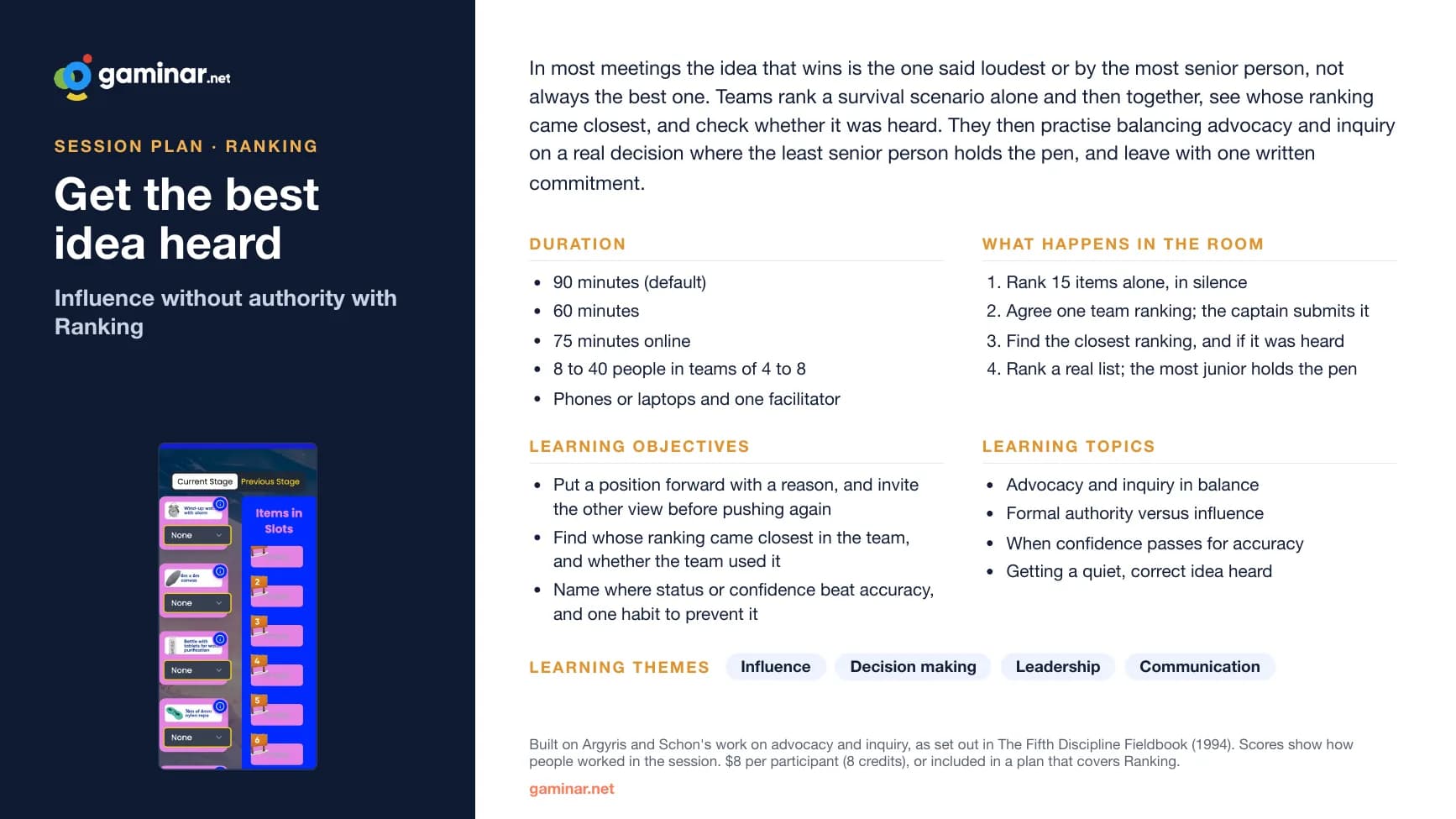
In most meetings the idea that wins is the one said loudest or by the most senior person, not always the best one. Teams rank a survival scenario alone and then together, see whose ranking came closest, and check whether it was heard. They then practise balancing advocacy and inquiry on a real decision where the least senior person holds the pen, and leave with one written commitment.
A story you will recognise
A project analyst in a matrix team spots that a key supplier cannot deliver on time. In the steering meeting she says it once, as a conclusion: 'I think the supplier is a risk.' The programme director, confident and senior, says it is covered, and the meeting moves on. Nobody asks what she saw, and she does not say. Three months later the delay lands exactly where she said it would. This session lets people see that pattern in a game, where the leaderboard shows whose ranking was closest and the team can check whether it was heard, and then practise the alternative on a real decision.
Who it is for
First-time managers, high-potential programmes, and people in matrix or project roles who must move decisions they do not own.
Use it when
- New managers, project leads or matrix roles need to move decisions they do not own.
- Good ideas from junior or quieter people keep getting lost in meetings.
- A high-potential programme needs a module on influence with evidence from the room, not a lecture.
- A team suspects that rank or confidence wins its arguments more often than the facts do.
Pick another plan when
- The real problem is a manager who punishes disagreement. Work on that with the manager first.
- The group is in open conflict about people rather than about the task. Deal with that first.
- You need a session on negotiation or bargaining. Ranking has no negotiation in it.
Learning objectives
What people leave able to do
- 1
Put forward a position with a reason and invite a counter-view before pressing it again, on a real work decision in round 2.
- 2
Use the leaderboard to find whose individual ranking came closest in their team, and judge from the scores and their own notes whether the team used it.
- 3
Name one moment in the game where status or confidence beat accuracy, and one habit that would prevent it at work.
The model
Balancing advocacy and inquiry
Argyris and Schon observed that, under pressure, most people argue for their own view and rarely test it. The alternative they described combines advocacy (saying what you think and why) with inquiry (asking how others see it and why). The Fifth Discipline Fieldbook turns that balance into practical moves. Four of them are behaviours you can see at a table, and none of them needs authority.
Show your reasoning
At work: Say what you saw, what you concluded and why, so others can follow the steps, not only the conclusion.
Invite the test
At work: End your case with a real question, 'Where do you see it differently?', and wait for the answer.
Ask for their reasoning
At work: Ask how the other person reached their view, especially the most senior or most confident person, before you counter it.
Say where you are unsure
At work: Name the part you are least sure of. It gives others a way in to add what they know.
Source: Chris Argyris and Donald A. Schon, Theory in Practice: Increasing Professional Effectiveness, Jossey-Bass, 1974; Peter M. Senge, Art Kleiner, Charlotte Roberts, Richard B. Ross and Bryan J. Smith, The Fifth Discipline Fieldbook, Currency Doubleday, 1994, section 'Balancing advocacy and inquiry'.
The session at a glance
The 90-minute version. The pack has the script for every block.
| Clock | Min | Block |
|---|---|---|
| 0:00 | 5 | Join |
| 0:05 | 5 | Open and prebrief |
| 0:10 | 3 | Connect |
| 0:13 | 4 | Briefing |
| 0:17 | 8 | Stage 1: alone |
| 0:25 | 11 | Stage 2: as a team |
| 0:36 | 2 | Influence check |
| 0:38 | 4 | Results |
| 0:42 | 10 | Debrief 1: Feel and What |
| 0:52 | 7 | The model |
| 0:59 | 3 | Team habit and pen holder |
| 1:02 | 13 | Round 2: the real decision |
| 1:15 | 9 | Debrief 2: So what and Now what |
| 1:24 | 4 | Commitment |
| 1:28 | 2 | Close |
In the full plan
- A minute-by-minute run sheet for 90 minutes, with 60-minute, half-day and online versions
- A script: what to say, what to ask and what to listen for
- The debrief, step by step, and how to carry it back to work
- A one-page handout per participant and an observer sheet
- Slides with speaker notes, and a one-pager to send your client
Word and PowerPoint, so you can make it yours. Read once. 20 minutes of set-up on the day, plus one rehearsal on your own phone.
One Ranking session: 8 credits ($8) per participant who joins, or included in a plan that covers Ranking. Round 2 is on paper and costs nothing. Observers who do not join cost nothing. A second scored scenario is a second session and costs 8 credits per participant again, unless a plan covers Ranking.
More with Ranking
Other session plans on the same game
Consensus decisions
Decide better together than alone
See the planConstructive disagreement
Disagree to decide better
See the plan
Rehearse it for free before your first real group
Sign up in two minutes, get 100 free credits, and rehearse any game as often as you like: sessions with up to 2 participants are always free.