
Constructive disagreement · with Ranking
Disagree to decide better
Everyone ranks a survival scenario alone before the team talks, keeps that view on screen while the team agrees one ranking, counts how many people say they kept a disagreement to themselves, and practises four habits that make disagreement about the task useful to the decision.
- 90 minutes (default) · 75 minutes · 75 minutes online
- 8 to 40 people in teams of 4 to 8. One facilitator up to about 24 people; add observers above that.
Free with every account, 100 credits included. It arrives in the app's Resources on 16 October 2026; sign up now and it is there that morning.
What happens in the session
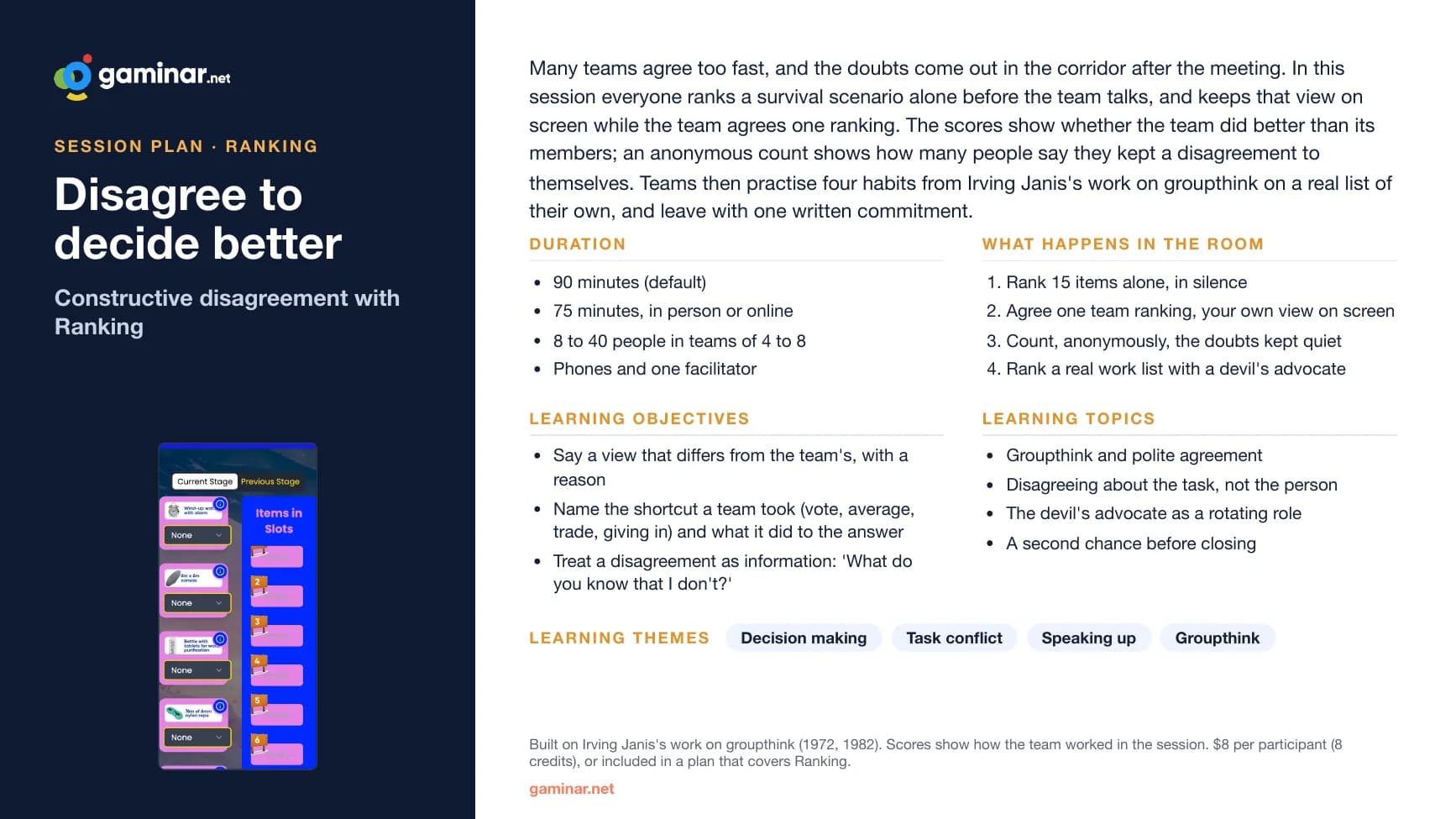
Many teams agree too fast, and the doubts come out in the corridor after the meeting. In this session everyone ranks a survival scenario alone before the team talks, and keeps that view on screen while the team agrees one ranking. The scores show whether the team did better than its members; an anonymous count shows how many people say they kept a disagreement to themselves. Teams then practise four habits from Irving Janis's work on groupthink on a real list of their own, and leave with one written commitment.
A story you will recognise
A product team agrees in ten minutes to ship a new feature in the next release. The head of product opens with her view, two people add their support, and nobody objects. After the meeting, the support lead tells a colleague that customers have asked for the opposite, and the tester says she had seen the same risk. Neither said it in the room because the decision already seemed made. The release slips by six weeks. This session lets the team see, in a game where it costs nothing, how often a different view stays unsaid, and practise making disagreement a job rather than a risk.
Who it is for
Teams prone to groupthink or polite agreement: long-standing teams, teams with a strong leader, teams that value harmony. Also the conflict module of management programmes, as its session on disagreeing about the work. It is not a session on personal conflict or mediation.
Use it when
- Meetings end with everyone nodding, and the doubts come out in the corridor afterwards.
- A team is proud of getting along and rarely challenges a plan, least of all the leader's.
- The conflict module of a management programme needs a practical session on disagreeing about the work.
- A new or merged team needs a shared way to disagree before the big decisions arrive.
Pick another plan when
- The group is in open conflict about people rather than about the task. This is not mediation; deal with that first.
- Speaking up carries a real risk right now (a restructuring, a disciplinary case). Talk to the sponsor before you run it.
- You need a decision on the real list today. Round 2 is practice; the decision belongs to its owner.
Learning objectives
What people leave able to do
- 1
Say out loud a view that differs from where the team is heading, with a reason, starting from the ranking they made alone (Stage 1 in the game, on paper in round 2).
- 2
Name any shortcut their team took (a vote, an average, a trade or giving in) and what it did to the team's answer.
- 3
In round 2, treat at least one disagreement as information by asking 'What do you know that I don't?' before replying.
The model
Janis's remedies for groupthink
Irving Janis studied policy decisions that went badly, such as the Bay of Pigs invasion, and called the pattern groupthink: keeping the group in agreement starts to matter more than testing the decision. Two of its signs are easy to see in a game: self-censorship (keeping a doubt to yourself) and the illusion of unanimity (taking silence for agreement). Janis proposed remedies. Four of them are behaviours a team of six can practise in fifteen minutes.
Doubts are everyone's job
At work: Before a decision, everyone is expected to raise doubts, not only the 'difficult' person. The person who disagrees gets asked before they get answered.
The leader speaks last
At work: The most senior person asks first and gives their own view last, so the room is not anchored on it.
A named devil's advocate
At work: For a big decision, name a devil's advocate and rotate the role from one meeting to the next.
A second chance before closing
At work: Before closing a decision, go round the table: 'What doubt do you still have?' Then decide.
Source: Irving L. Janis, 'Victims of Groupthink', Houghton Mifflin, 1972; second edition published as 'Groupthink: Psychological Studies of Policy Decisions and Fiascoes', Houghton Mifflin, 1982. The four habits below adapt four of the remedies he proposed.
The session at a glance
The 90-minute version. The pack has the script for every block.
| Clock | Min | Block |
|---|---|---|
| 0:00 | 5 | Join |
| 0:05 | 5 | Open and prebrief |
| 0:10 | 3 | Connect |
| 0:13 | 4 | Briefing |
| 0:17 | 8 | Stage 1: alone |
| 0:25 | 12 | Stage 2: as a team |
| 0:37 | 2 | Before the scores |
| 0:39 | 3 | Results |
| 0:42 | 10 | Debrief 1: Feel and What |
| 0:52 | 6 | The model |
| 0:58 | 2 | Round 2 set-up |
| 1:00 | 14 | Round 2: the real list |
| 1:14 | 9 | Debrief 2: So what and Now what |
| 1:23 | 5 | Commitment |
| 1:28 | 2 | Close |
In the full plan
- A minute-by-minute run sheet for 90 minutes, with 60-minute, half-day and online versions
- A script: what to say, what to ask and what to listen for
- The debrief, step by step, and how to carry it back to work
- A one-page handout per participant and an observer sheet
- Slides with speaker notes, and a one-pager to send your client
Word and PowerPoint, so you can make it yours. Read once. 20 minutes of set-up on the day, plus one rehearsal on your own phone. Bring two sticky notes per person.
One Ranking session: 8 credits ($8) per participant who joins, or included in a plan that covers Ranking. Round 2 is on paper and costs nothing. A second scored scenario is a second session and costs 8 credits per participant again, unless a Ranking plan covers it.
More with Ranking
Other session plans on the same game
Consensus decisions
Decide better together than alone
See the planInfluence without authority
Get the best idea heard
See the plan
Rehearse it for free before your first real group
Sign up in two minutes, get 100 free credits, and rehearse any game as often as you like: sessions with up to 2 participants are always free.